
wudang trip 2026
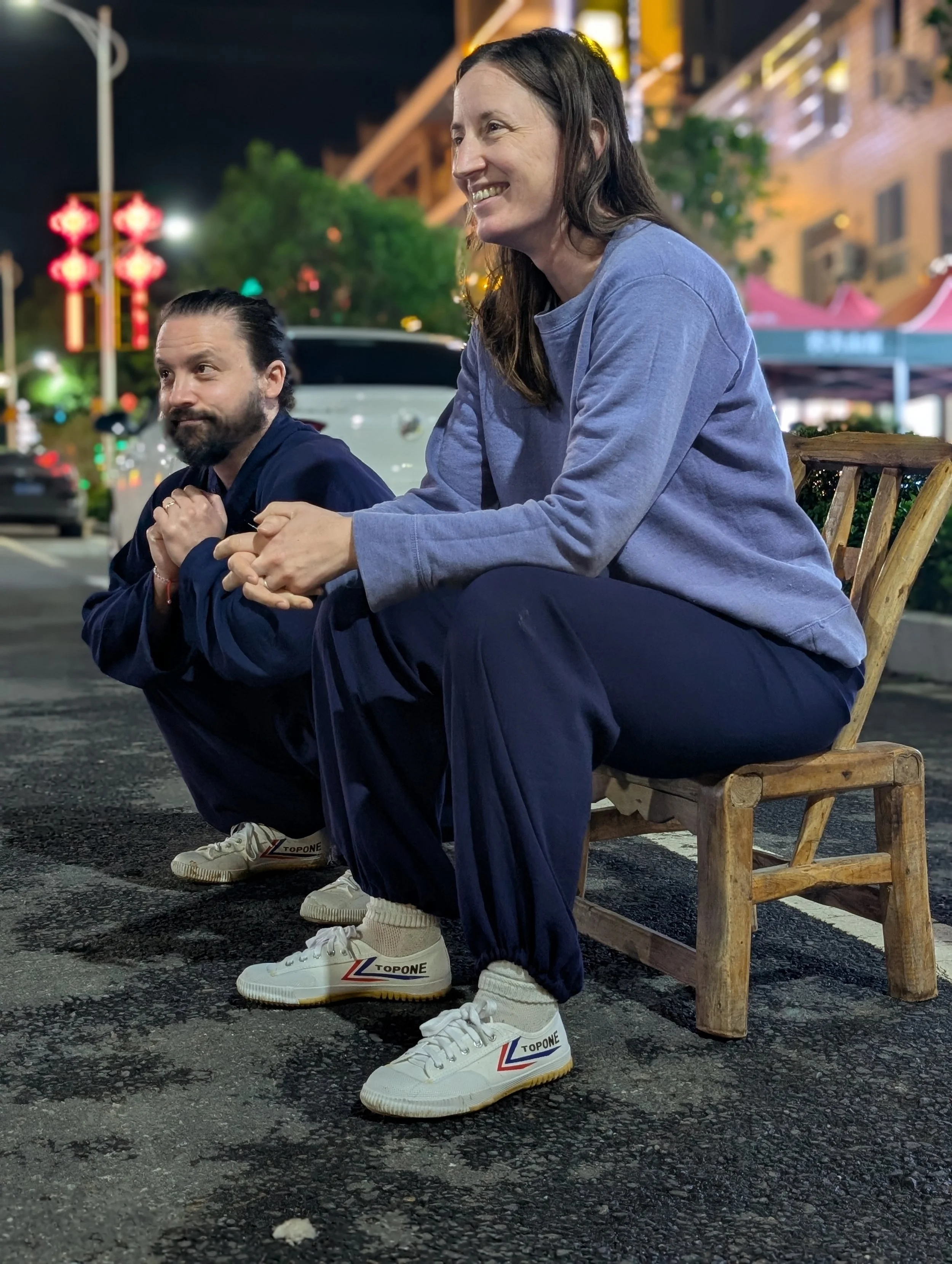
Chinamaxxing in Wudang, “Heels on the ground, comrade found. Heels in the sky, western spy.”
We just got back from our second school trip to China. Brandi and I and seven students all flew into Shanghai where we quickly met up with kung fu brother Jeff Reid from Wudang Santa Cruz and four students of his. We had a great couple days in Shanghai, visiting the Jing An Temple 静安寺, eating amazing food, and just wandering around. Setting the pattern for the rest of the trip, we took a little jaunt down to Hangzhou 杭州 to visit our kung fu brother Ziqin at his beautiful school where he teaches out of an old rice shipping depot that’s in the process of being renovated into art spaces. When we were training with master Yuan, the foreign traditional class was known as Sanban 三班, or “third class,” and we trained really closely with the Chinese students in Erban 二班 (second class), as well as Yiban 一班 (first class), so a lot of this trip was us going around and visiting all our brothers in their kung fu schools, many of them newly opened. Ziqin, was an erban kid who was at master Yuan’s school the entire six years we were there. More than that, he and Brandi were both roughly the same size so they were often paired up for sparring! Now he runs a successful school in the burgeoning tech metropolis of Hangzhou, a beautiful space beside an ancient canal.
There’s a lot written about martial brotherhood in the history of Chinese martial arts, and master Yuan was always accentuating the importance of these lateral relationships. The kind of collective suffering you all go through, all that “eating bitter” 吃苦, creates bonds that are impervious to the vicissitudes of life and of fortune. It’s now twelve years since our class finished in 2014. The traditional model is that after a period of intense training with your master, you leave the temple, leave the mountain, leave your brothers, and wander (they call it cloud wandering 云游), experiencing what we in the modern era might call “the real world,” but which Daoists more accurately labelled the mundane world of red dust 紅塵俗世. After your period of wandering your return to your master, return to the mountain. In this crazy world of the 21st century, it seems like this old mythic pattern is taking shape by having us and all our brothers “return to the mountain” by opening our own schools, establishing little Wudangs wherever it is we find ourselves.
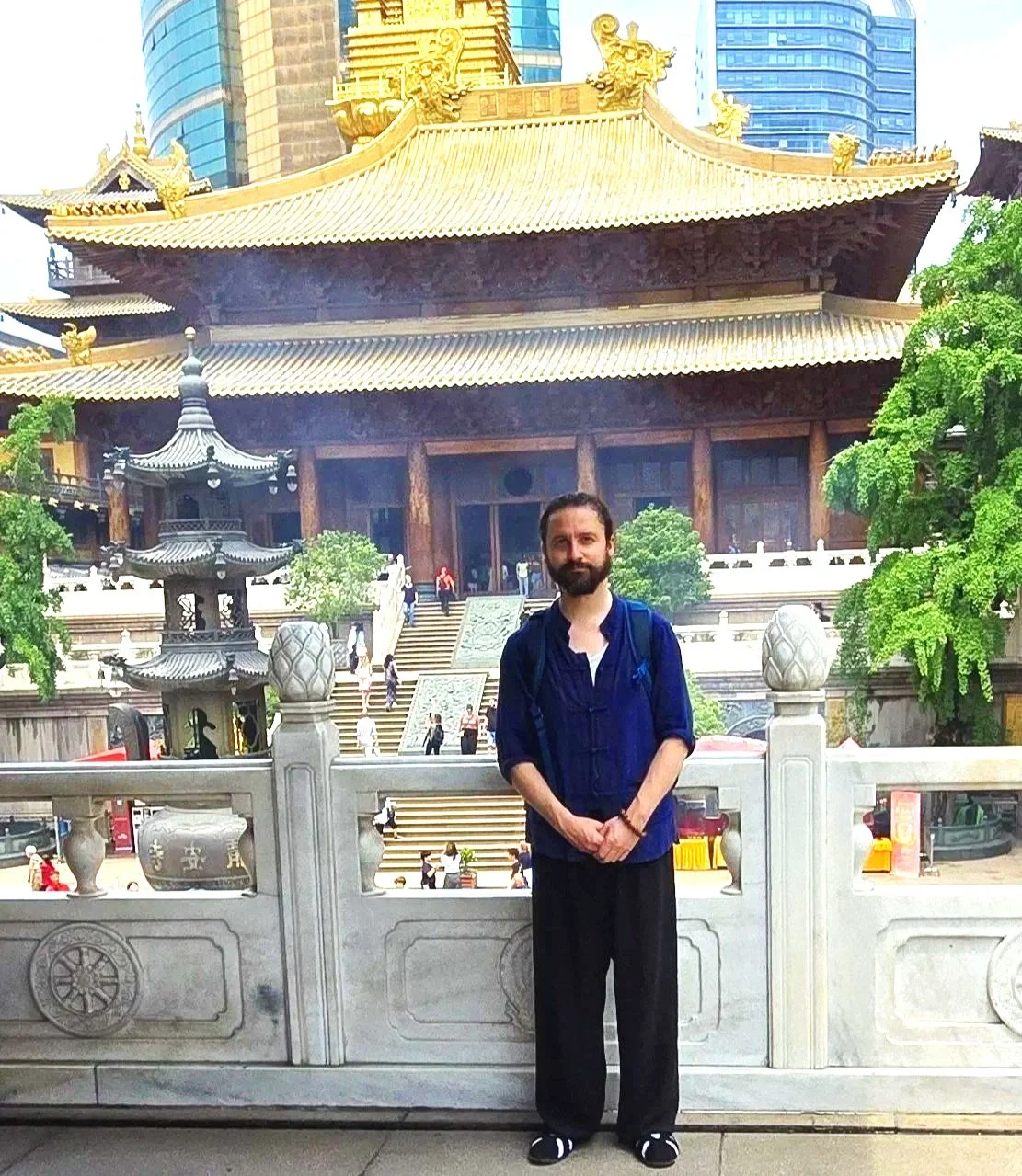
Me at the Jing An temple 静安寺 right in the middle of Shanghai where the Shingon 真言 master Chisong 赤松 (1894–1972) championed a revitalization of esoteric Buddhism in the 20th century. I had really wanted to come here ever since hanging out with a really cool Chisong scholar, Hai Jin, at Harvard last fall.
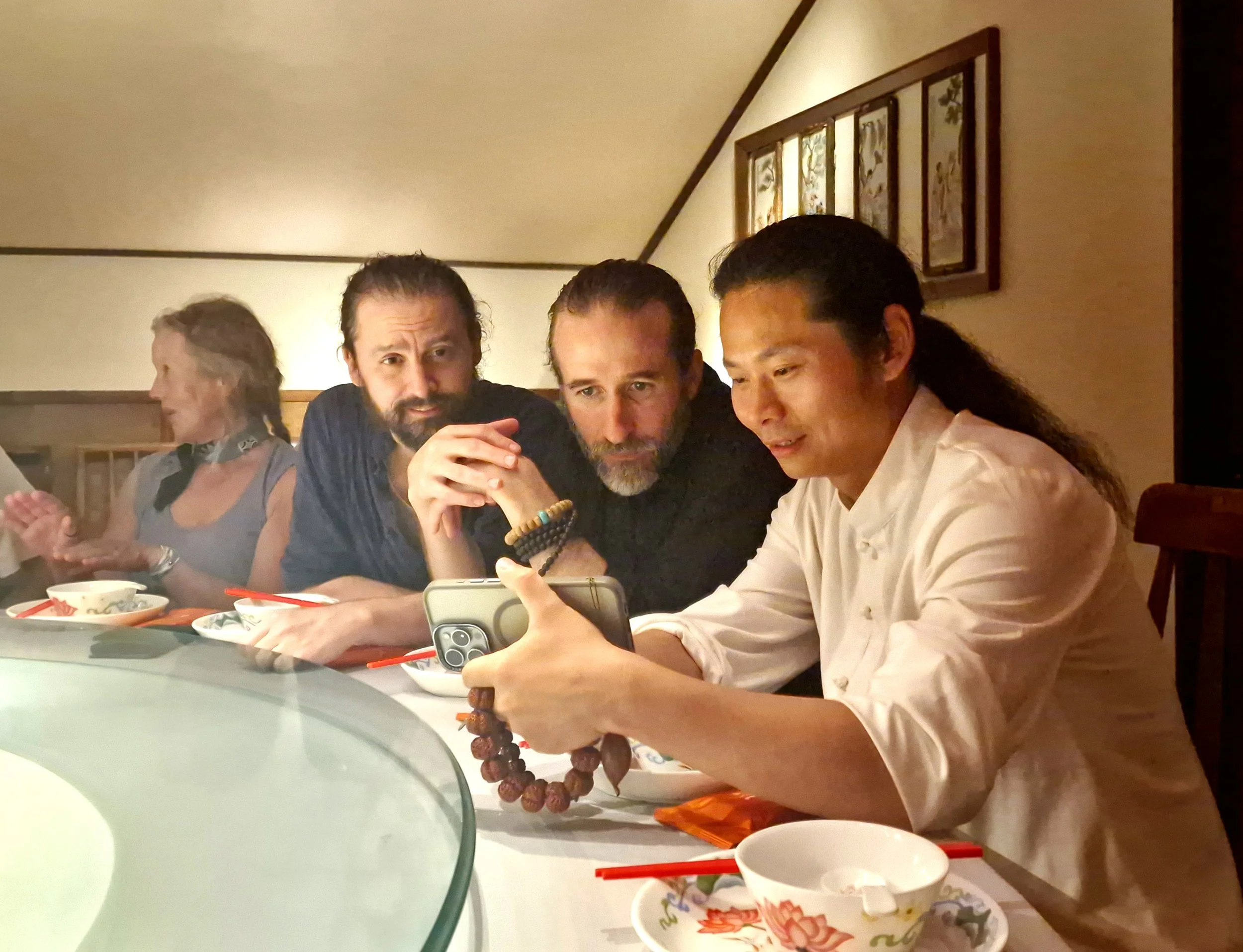
Ziqin资勤 showing us his new BMW motorcycle
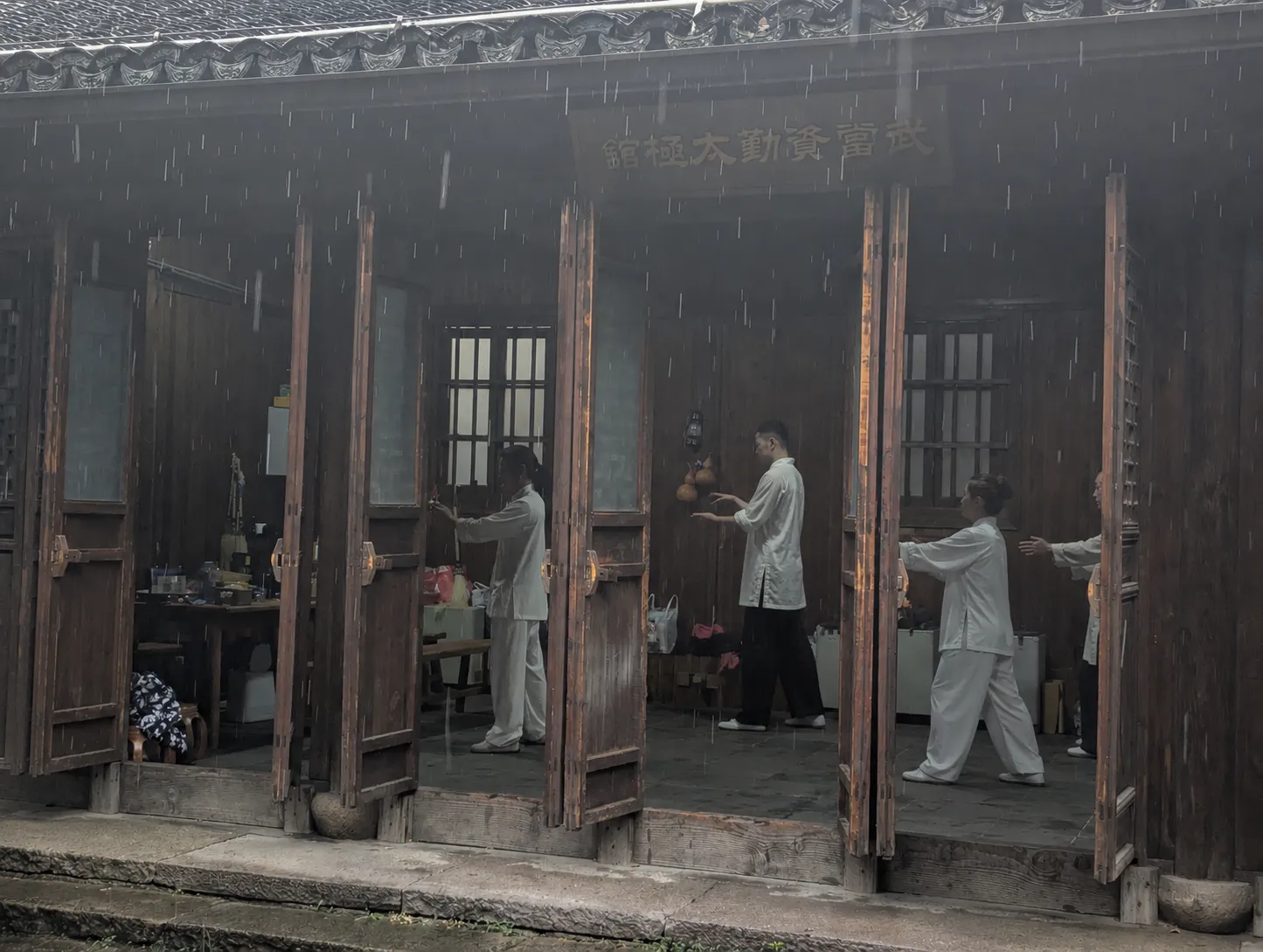
Ziqin 资勤 teaching at his school in Hangzhou, the Wudang Ziqin Taiji Academy 武当资勤太极馆
After Shanghai we flew to Wudang where we stayed at a the beautiful Yuanhe Meisu 元和美宿, a traditional style inn right next to one of the classical Wudang temples, the Observatory of Primordial Harmony 元和观, which, according to the local folklore, was the Daoist prison where the Wudang establishment would remand monks who had broken monastic vows. A lot of the traditional statuary from that temple was frightening hell beings, meant to scare the monks straight, I presume. We took our students all around town — to the tailor, to the blacksmith, to the market — just to get everyone a bit oriented, and then we dropped them off at master Yuan’s school and introduced them to our kung fu brother Gao 张文高 (Zikai 资开) who we roped into teaching them. Gao just had another kid, so he’s got a one-month old and a three-year old at home, and the morning our students arrived he was basically up all night and then got yelled at by Shifu for showing up to class late, so when I brought seven students to him and asked him to teach them he was initially very grumpy. But that’s the thing about Gao, ever since I’ve known him, he has this gruff exterior but underneath it all he’s a big teddy bear. The students all loved him. He was so sweet to them.
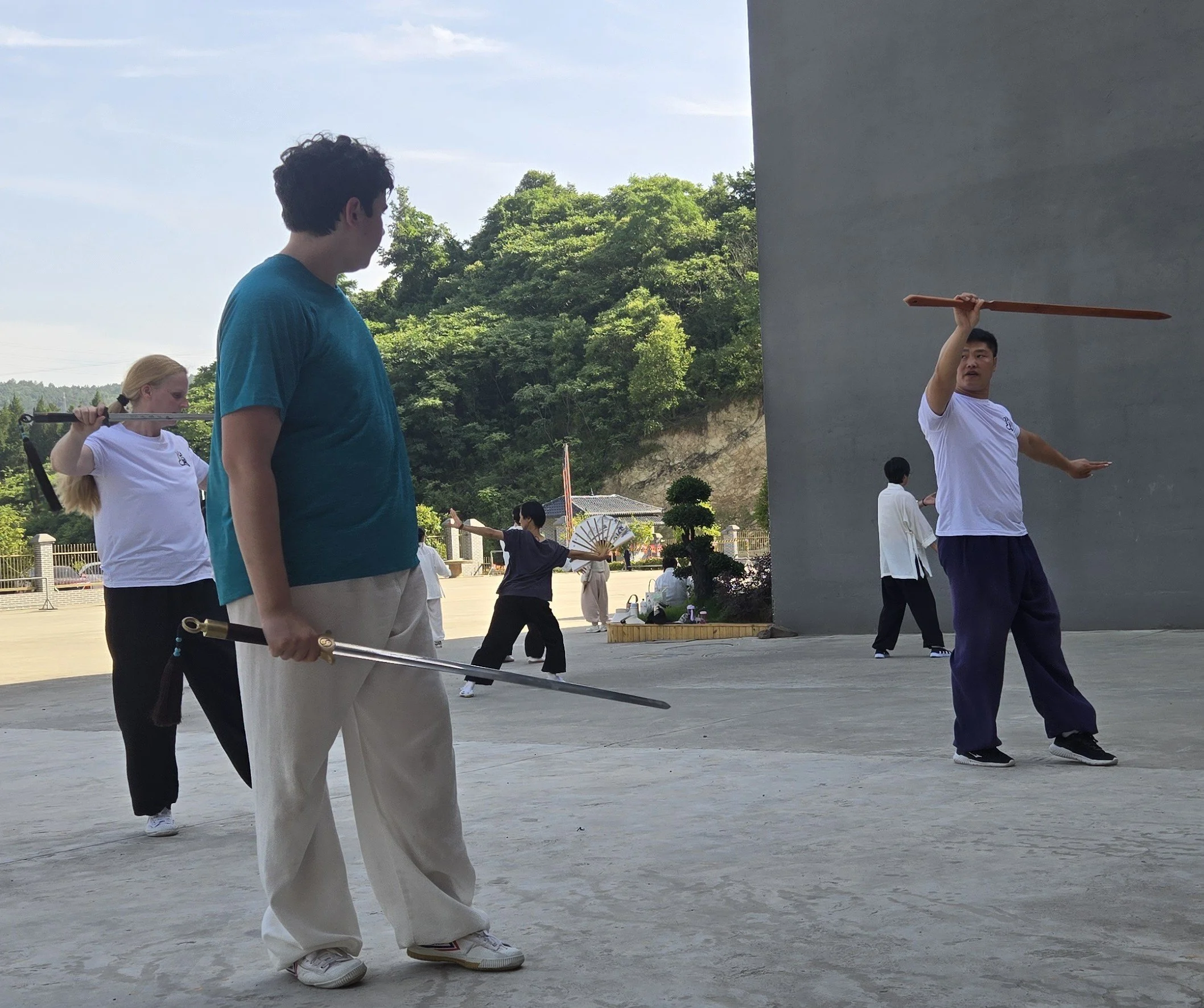
Gao teaching Dragon Sword 龙华剑
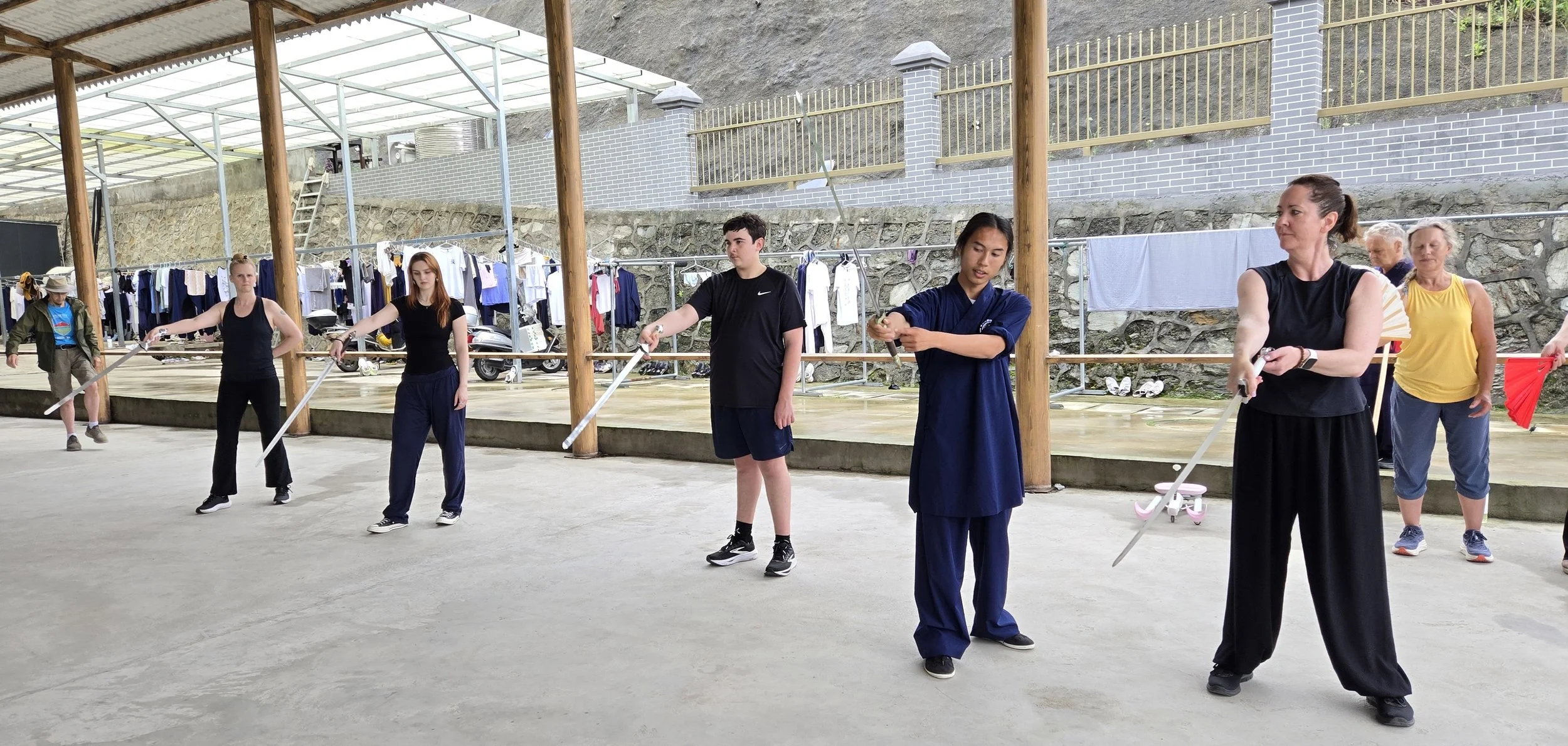
Students learning sword basics (the classic fundamental Jian technique, Dian 点) from one of Gao’s assistant instructors.
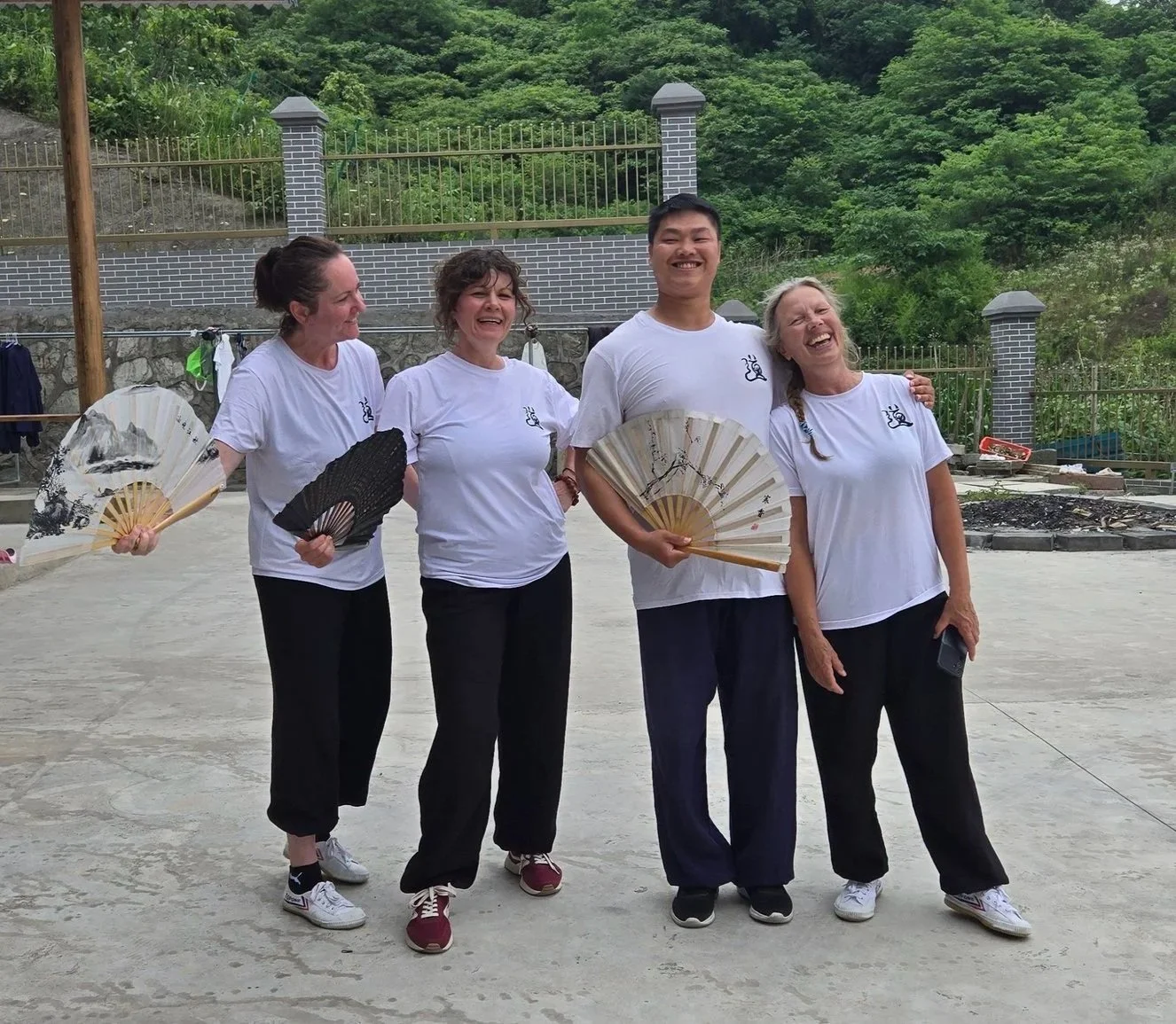
Gao with the students who learned the Free and Easy Fan 逍遥扇
Brandi went to check on the students (and take pictures) at master Yuan’s school every couple of days, but I basically just dropped them off and left them in Gao’s hands. After my last China trip in 2024 I started working on translating this prayerbook with our kung fu brother Jake, who has been living in Wudang since 2010 and is now pretty famous online. When I was there in 2024 we were reminiscing about the morning and evening prayers 玄门日诵早晚功课经 we had studied with Master Yuan, and I remarked that in the intervening years I had translated all of the prayers and was planning on writing them all down in musical notation. Jake told me he had put them all down in musical notation and was planning on translating them, hah! Ever since then we’ve been meeting every Friday to go through the prayers. We’re planning on publishing a comprehensive version through the Wudang Daoist college, with translation, historical context, and tablature. Downstream of that, Jake, his partner Lingling, Jeff, Brandi and I founded an international society called the International Wudang Sanfeng Association 武当三丰国际协会 just to have a kind of legal entity to bring all the stuff we’re working on together. So a big part of the trip this time was meeting with people to help get this thing off the ground.
Our first meeting was with Master Li 李老师, a Daoist master from the Qingwei sect 清微派, a Thunder Rites lineage, who is the head master of talisman writing at the Wudang Daoist college and also the head of the music ensemble. When Jake and I have been working through the morning and evening prayers, every time we have a question we ask master Li and he always has a very learned and often unexpected (and more often than not, humorous) explanation. It was really cool to finally meet him. Over evening tea he explained how important the foreign proliferation of Daoism and Wudang culture is, and how us participating in the culture in China, showing up as Daoists, helps everything in China be more open and more free. It was so encouraging to hang with people like him. He’s an endless font of esoteric wisdom.
So, early in our stay Lingling got the word out to all our kung fu brothers, and we took everyone out to a big dinner, with Shifu and everyone who is still around from the old days. And then our real Wudang trip began. Over the next few days between Jianzi 袁慎建, our old kung fu brother who has been the coordinator at Shifu’s school from the start, and Jake and Lingling, we were driven all over the Wudang area to visit the schools of all our kung fu brothers and uncles, most of which just popped up in the last year or two.
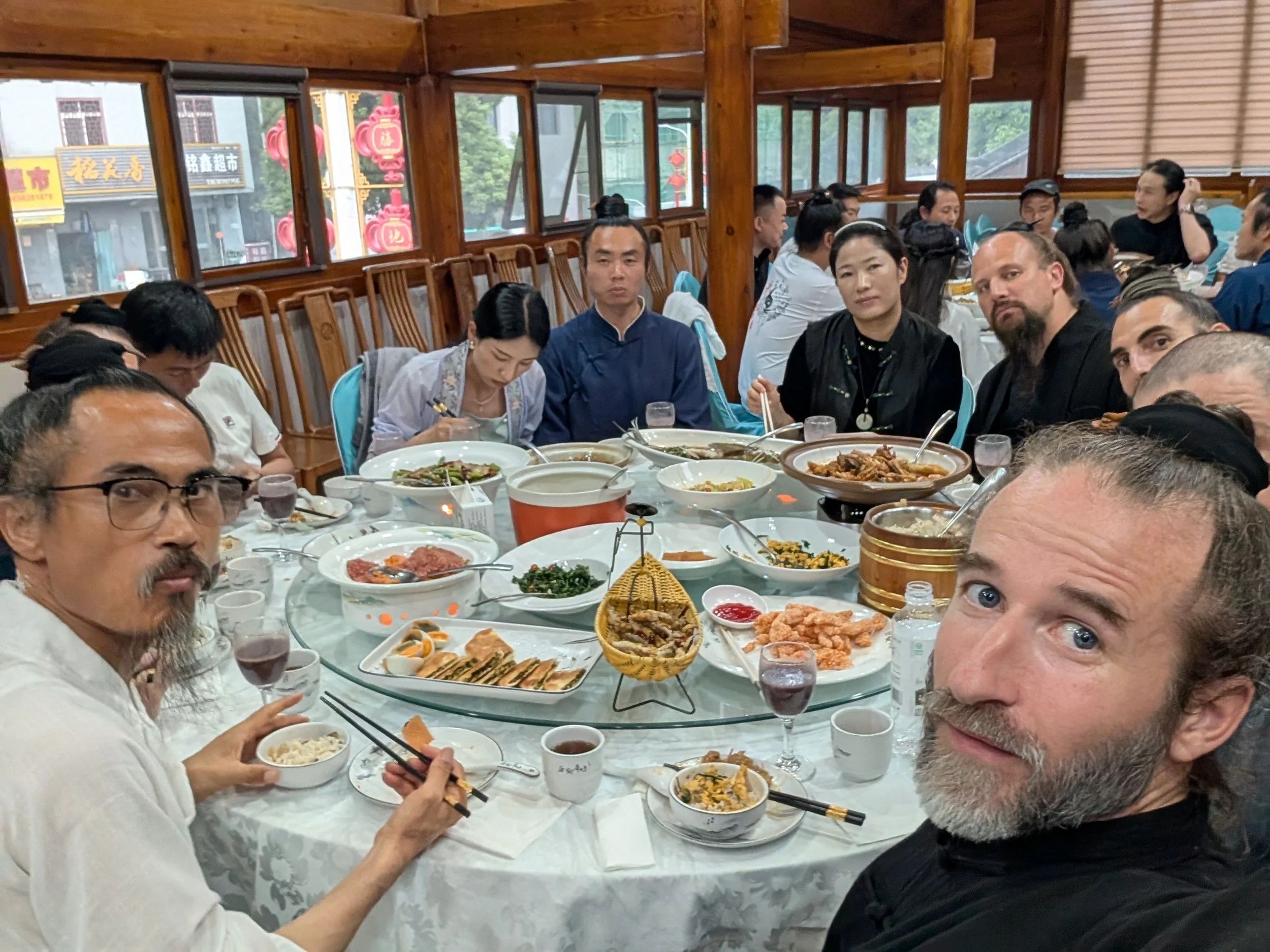
The Big Dinner with all our brothers. Shifu, of course, and Jeff taking the selfie. Across the table is Shifus’ daughter Xiaoyu and her husband Xiaoyun and Jake and Lingling. Brandi and I and Jianzi were just to Shifu’s left.
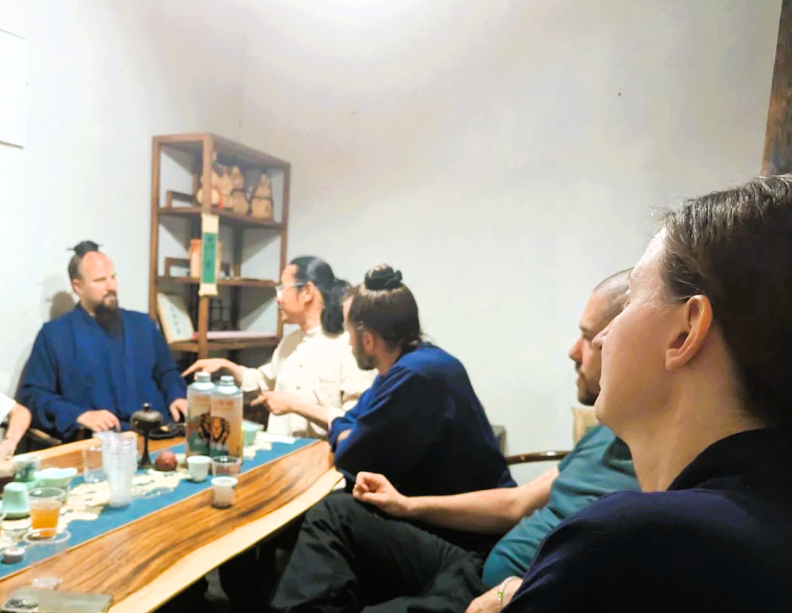
Drinking Pineapple beers with master Li late one evening
We even had very rare brothers vising from out of town. Zhang Jiming, who was actually my main sparring partner back in the day, was visiting from Myanmar where he’s been working on Chinese infrastructure projects. And Huang Jianjie 黄建杰 (资虎), who teaches martial arts at the White Cloud Temple 白云观 in Beijing was visiting, considering moving back to Wudang. When I added him on Wechat I jokingly said “加个朋友” or “add a friend,” the phrase you click to add a friend on social media, and he corrected me and said “We are not friends. We are brothers. It’s a different kind of relationship.”
The first school Jianzi took us to was that of two of our closest older brothers, Yuan Huailiang 袁怀亮 (资煌) and Wang Yinhua 王音华 (资迪), who had opened a school in the Wudang countryside. We sat and reminisced about the old days and talked about the kind of training we went through and its possibilities and impossibilities in the more complicated world of today. After tea with Huailiang we drove over to Uncle Wang’s 王志强 school (Daoist name Wang Shiyi 王师壹). He also had a nearby school in the countryside with a few students. He invited us in for tea and we swapped stories and asked about some of our long lost uncles and what everyone is up to. On our way out he gifted us some of his home-grown, home-processed Huangjing 黄精, a local potato-like root that you steam and dry nine times, creating a sort of sweet beef jerky-like substance that we’d eat on meditation retreats. It’s grown into a huge industry in the meantime and everyone and their mother is selling it now! Crazy to think the only way to get it when we lived there was to get the roots wildcrafted by local farmers or the monks in the deeper mountain temples and then to process it yourself.
Tea and jokes with Huailiang!
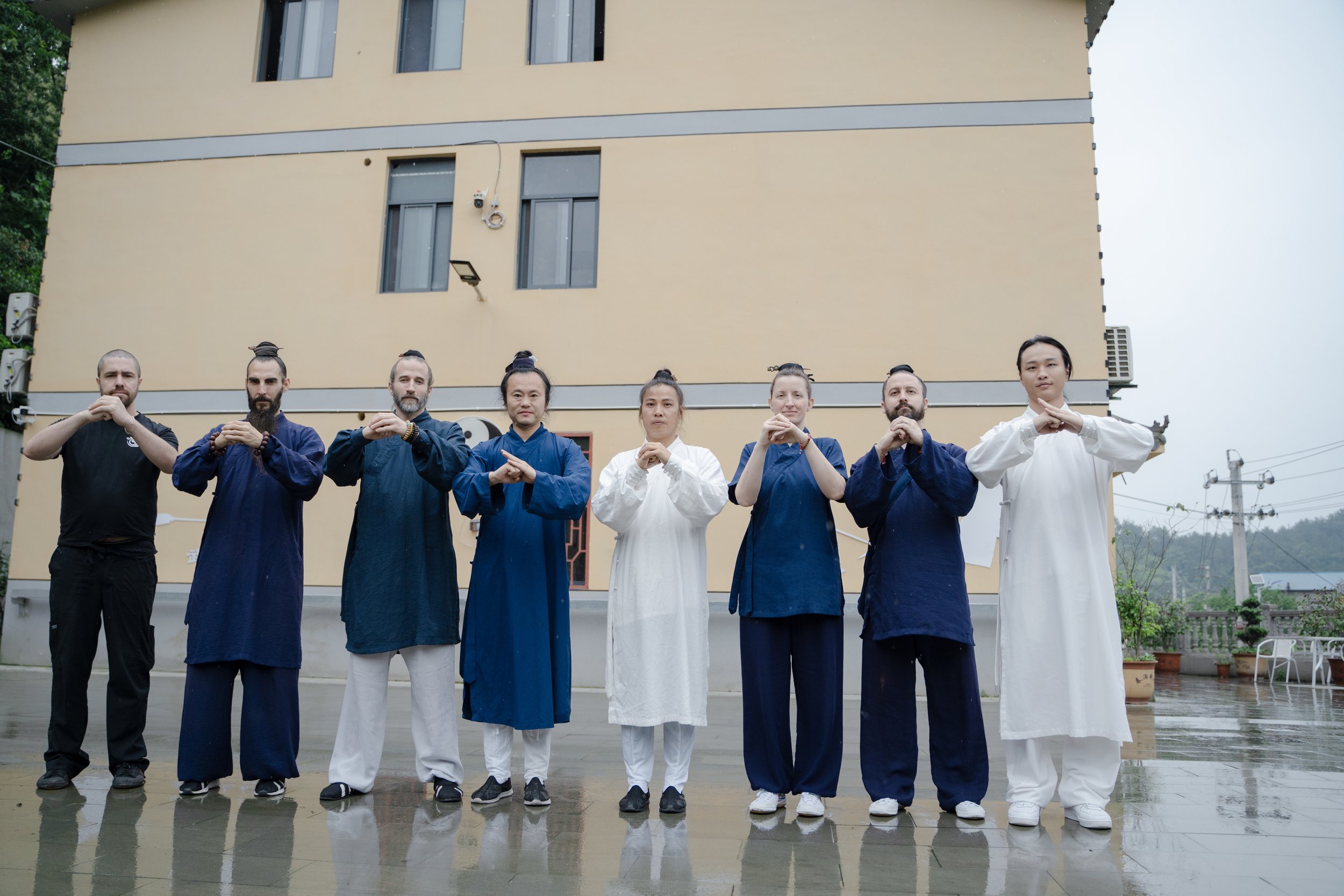
Bowing outside Huailiang’s and Wang Yinhua’s new school
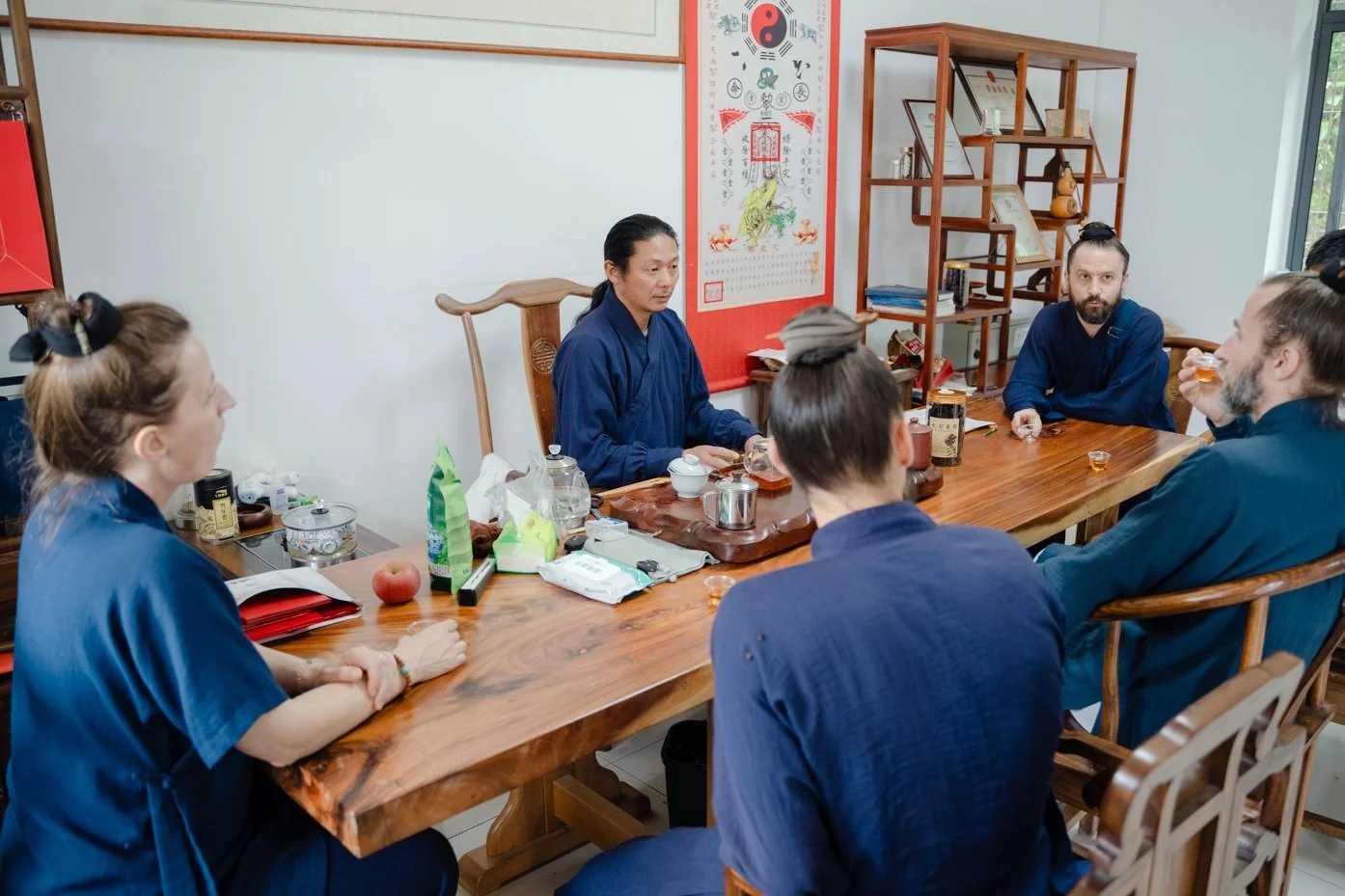
Tea with uncle Wang
After master Wang’s school we drove over to our brother Yuan Yi Hui’s 袁智慧 (资焘) school, a beautiful little spot with a koi pond out front and a garden out back where he grows his own veggies. He’s got twenty or so students training in a traditional class and he runs his school quite strict, like shifu did at our school in the old days. One day off a week, and no going into town unless you have urgent business to attend to. Really cool meditation hall at the top of the school with quite a collection of Tibetan singing bowls and a number of Tibetan Thangkas of different tantric deities. I asked him about it and he said those actually belonged to his wife, Dahai 大海, who was also an old friend of ours. She identifies as a Buddhist, following both Chinese and Tibetan forms of Buddhism, and weaves that into the meditation teachings at his school. We swapped stories of teaching and reflected on all the benefits of having a small school. Yihui said there’s a sort of goldilocks zone for a school, when its large enough to be self-sustaining, but not so big it is hard to manage. I told him I totally agreed but that he should tell shifu that! We all laughed. Shifu just keeps making his school bigger and bigger.
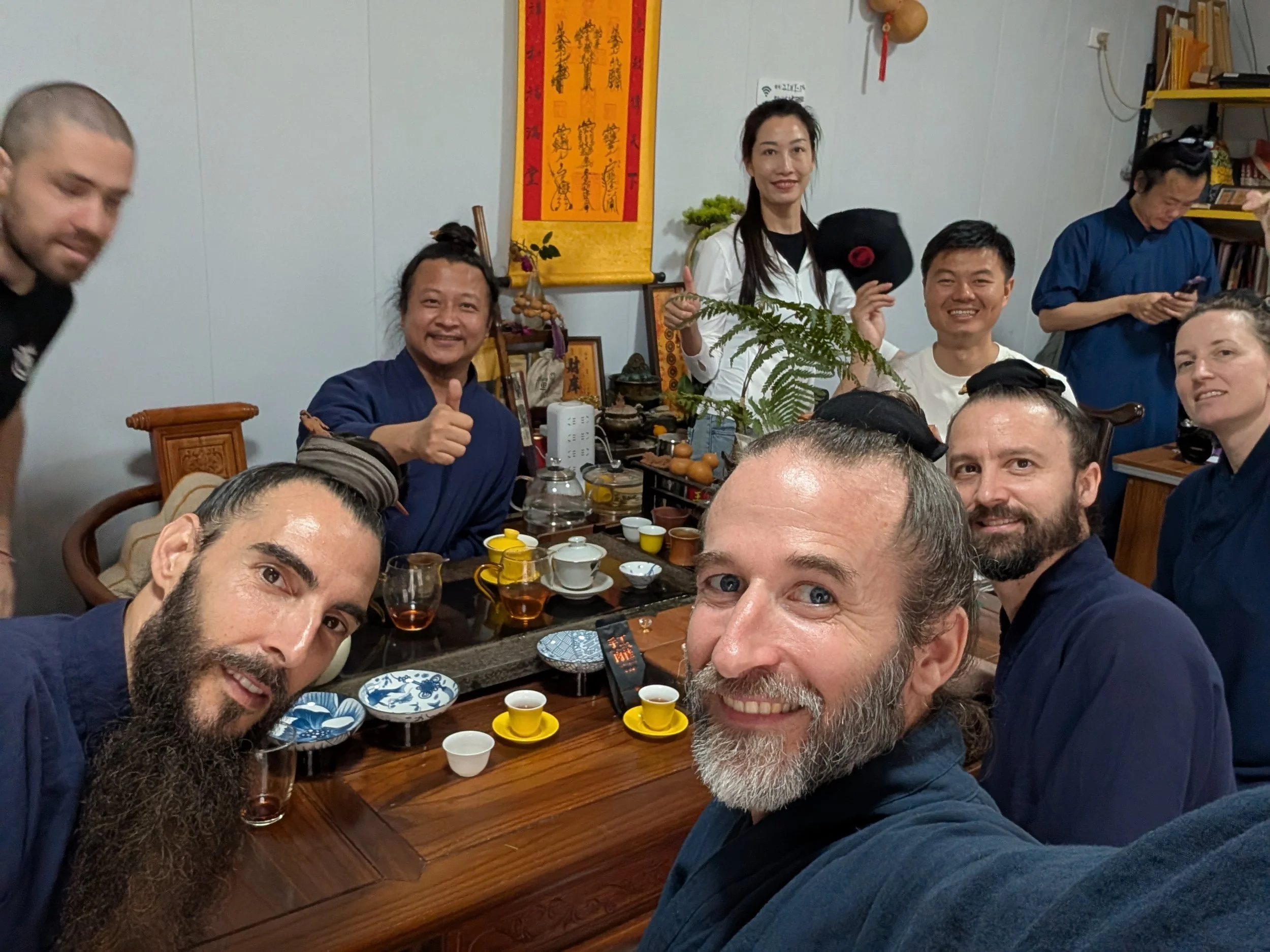
Tea with Yihui. Things got a little toasty there too. He gave us some of Uncle Wang’s medicinal homebrew and then some of his own Yaojiu. This is an old Daoist thing where you just add a bunch of medicinal herbs to a spirit, in Wudang it’s baijiu.
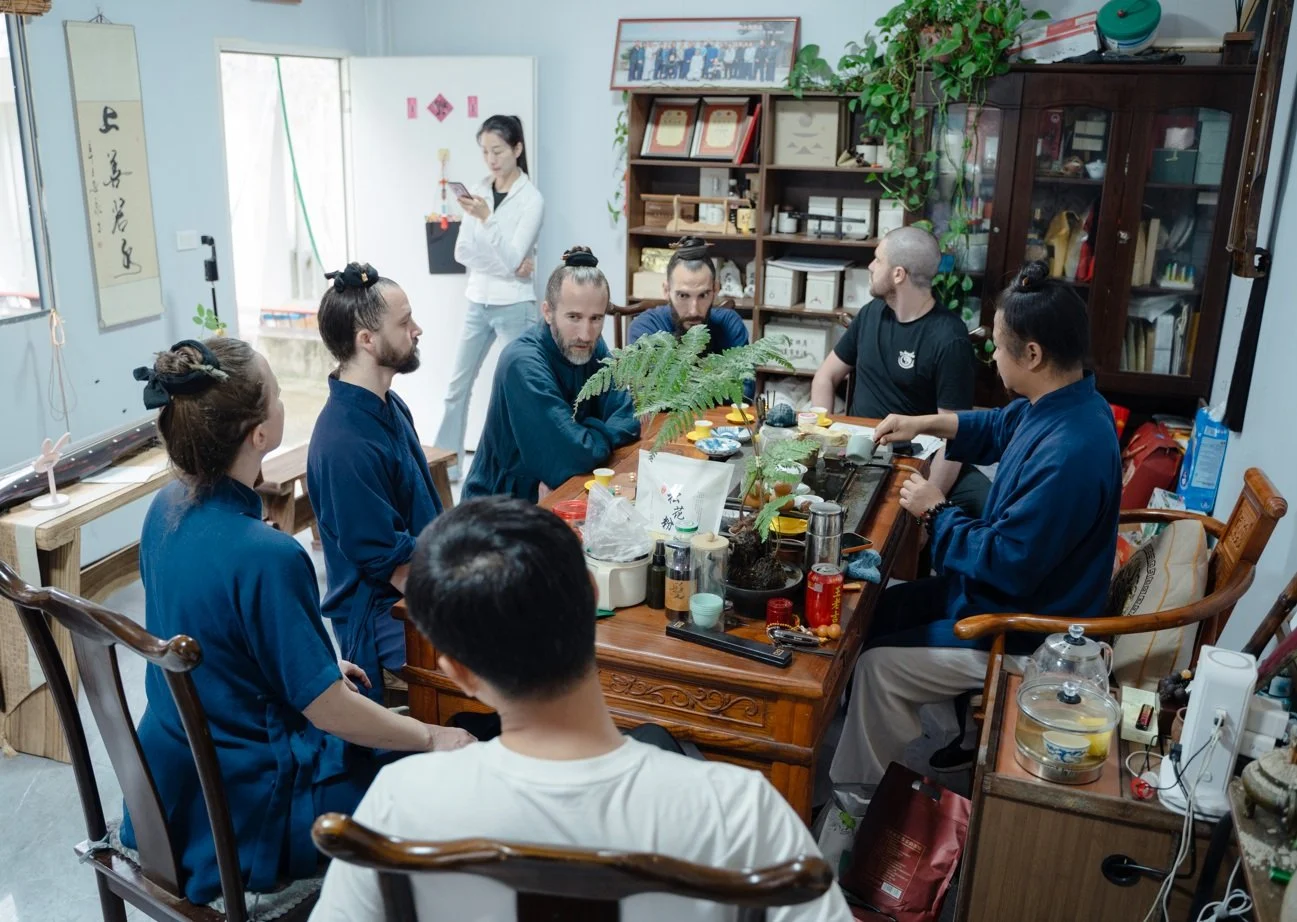
Another shot of Yihui’s lovely office/tea room. Yihui’s medicinal blend was quite nice, full of “desert ginseng” Roucongrong 肉苁蓉, a hardy plant from inner Mongolia. Uncle Wang’s was based on Huangjing and drinking it was like taking a 2×4 to the face. Classic Uncle Wang.
Ok there was one last stop for us that day and it was Jake’s new school! Jake is actually in the process of building TWO schools right now. One is a smaller joint just undergoing some renovation, and the other is quite a big operation that he’s building from scratch. It’s just astounding to see how fast building and renovation happen in China. Now, about a month later, Jake’s new school is already open. It’s another place in the Wudang countryside just a few minutes from the airport. And his new school is going up in the same neighborhood. I won’t post any spoilers. His future is quite bright though. It’s just amazing what’s happening in Wudang these days.
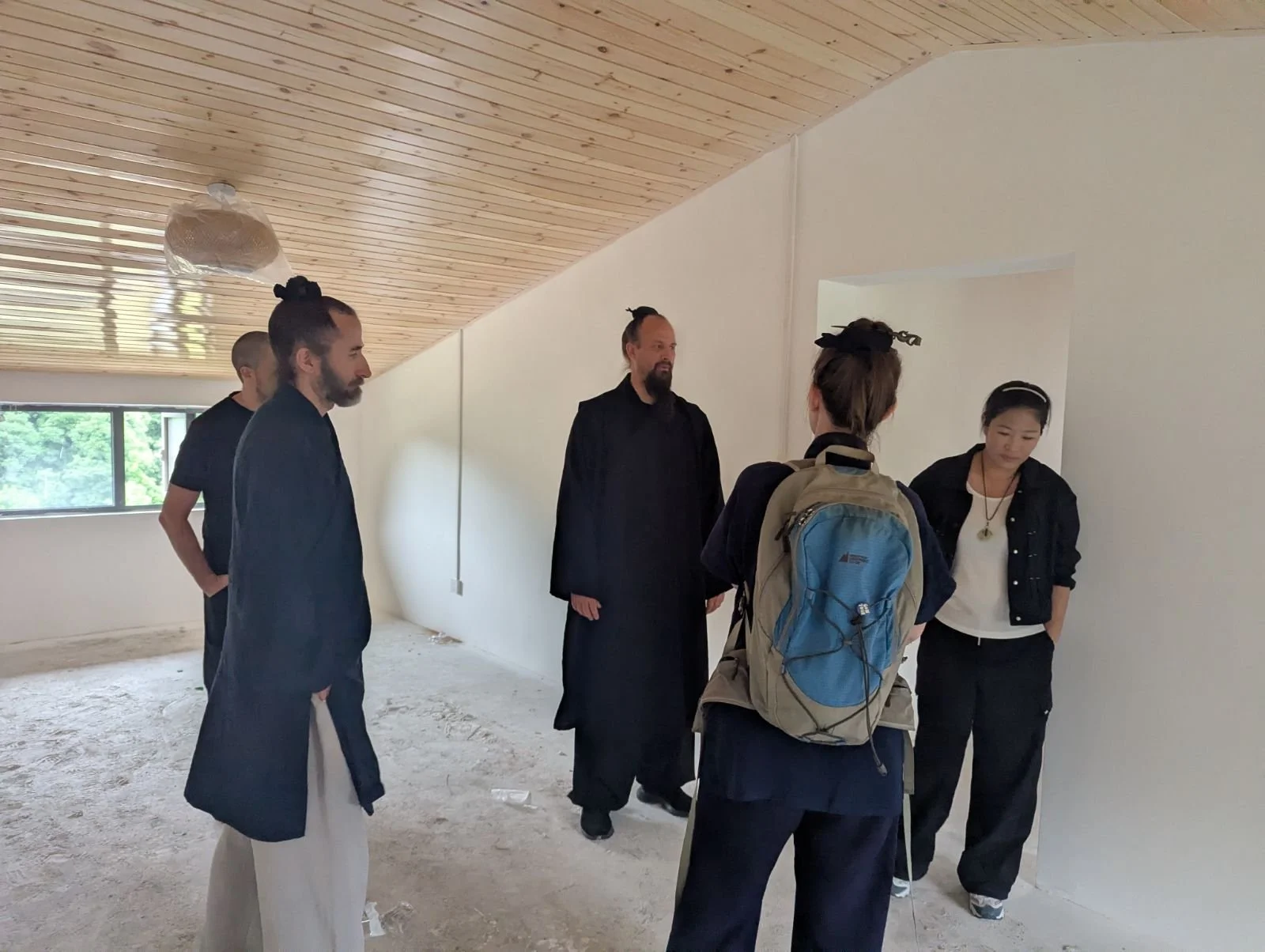
Upstairs at Jake’s new school, in the midst of renovation. They had just finished the drywall and there still weren’t any doors or really any finishings. When Brandi asked Jake when he thought the school would be open and he said “well I’m hoping for next week,” she said “Jake! Come on!” Jake actually used to do drywall and concrete and work in construction in the states and he said we just can’t possibly imagine how fast things happen in China. A week later his school was open, as planned.
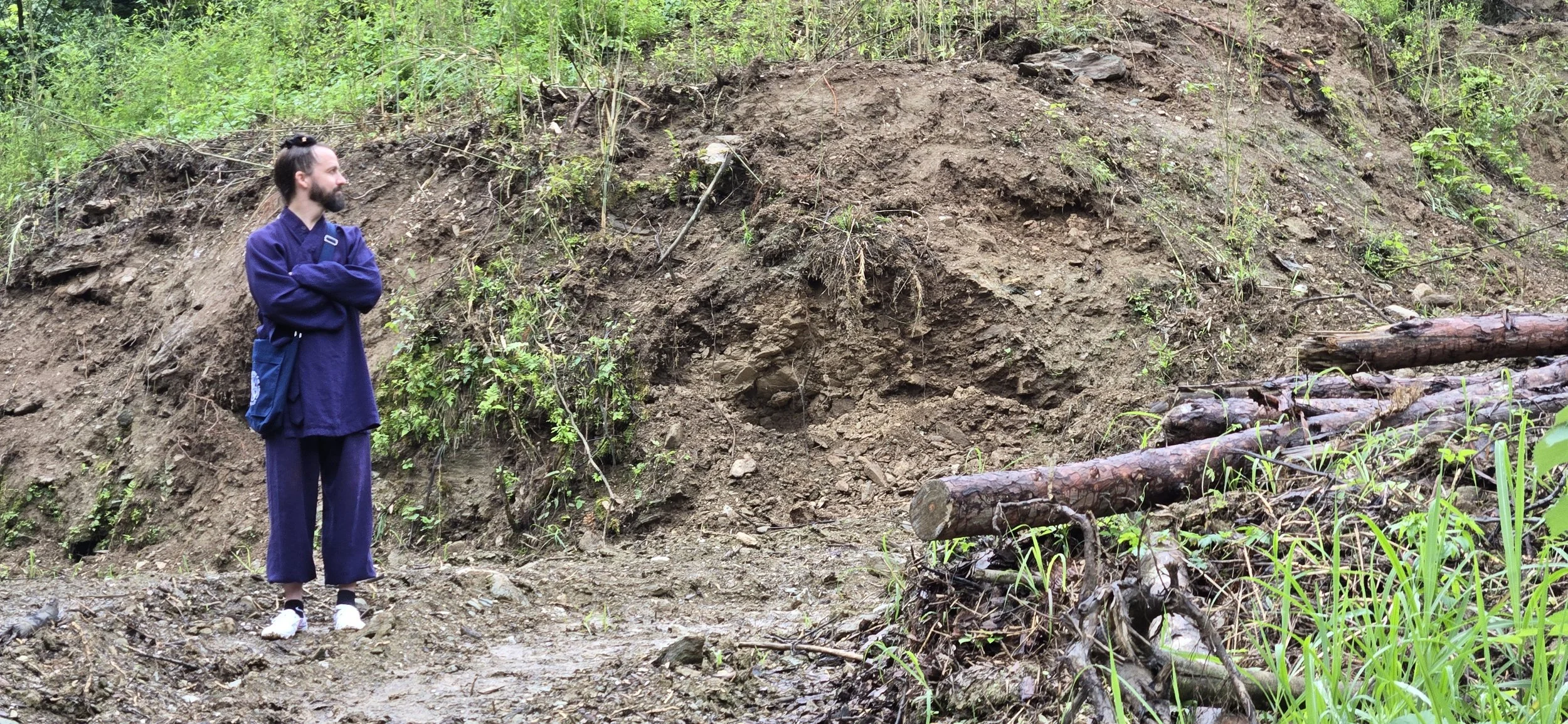
At the build site for Jake’s new school.
That weekend we led everyone up the mountain to visit all the old temples, beginning with Taizipo 太子坡 which houses the Observatory of Returning to the Real 复真观. I played tour guide, telling students about the history of the space and the mythical narrative that underlies all of Wudang: the life of Zhenwu 真武, the Perfected Warrior who ascended to heaven after 42 years of alchemical cultivation. Every place in Wudang is a part of Zhenwu’s story, and pretty much every temple has a statue of him in his different states of transformation and transfiguration. Taizipo is the most mundane, being where he met his master and started his studies. There is a shrine to Zhenwu as a child there, with his two buns. It’s traditionally a place people would go to pray for students and those engaged in literary studies — pray for a photographic memory or good grades on an exam. A building in the back of Taizipo was also the main library in Wudang, only recently reopened. It was razed in the Mongol invasion in the 1200’s and there was again a burning of books there during cultural revolution. It’s so fortunate in 2026 to go to Wudang in an era of renovation rather than destruction.
After Taizipo we took the bus to Zixiaogong 紫霄宫, Purple Cloud Palace, where master Yuan trained in the 1990’s. We had the good fortune of being there right when they were starting the evening prayers, so everyone got to see the monks and nuns burning incense and singing in front of the main altar. The evening prayers are sung in the hour of the rooster, when the Yang energy of the day is turning to Yin. Where the morning prayers are focused on the body and this life, the evening prayers center on the spirit and the afterlife, and many of the chants are the priests helping ferry lost souls into blessed realms. We made one last stop that day at Thunder Cave 雷神洞 up near the Southern Cliff Palace 南岩宫, maybe my favorite spot in all of Wudang, before retiring for the evening at this fancy new hotel they have up there.
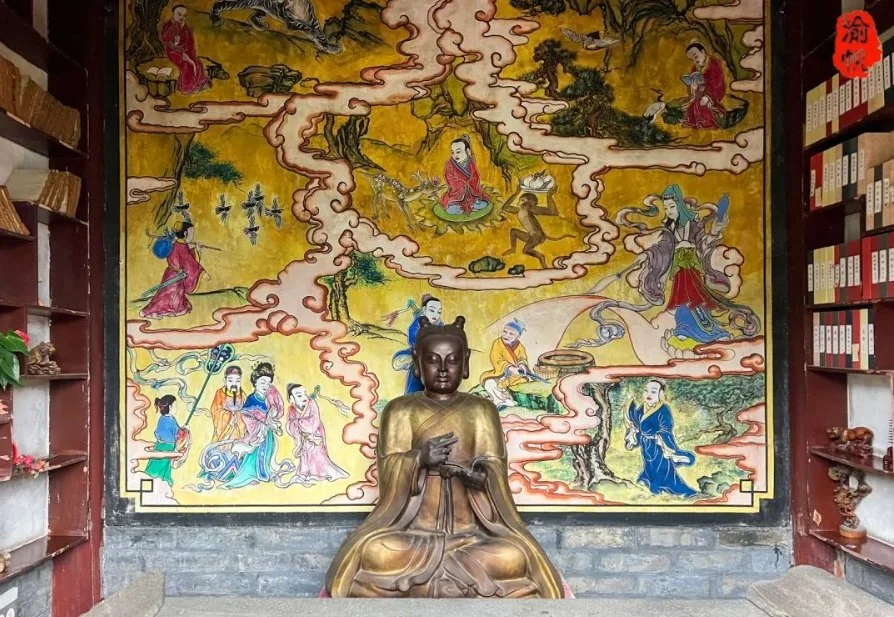
Zhenwu 真武 as the prince 太子, when he had just arrived at Wudang and was beginning his studies
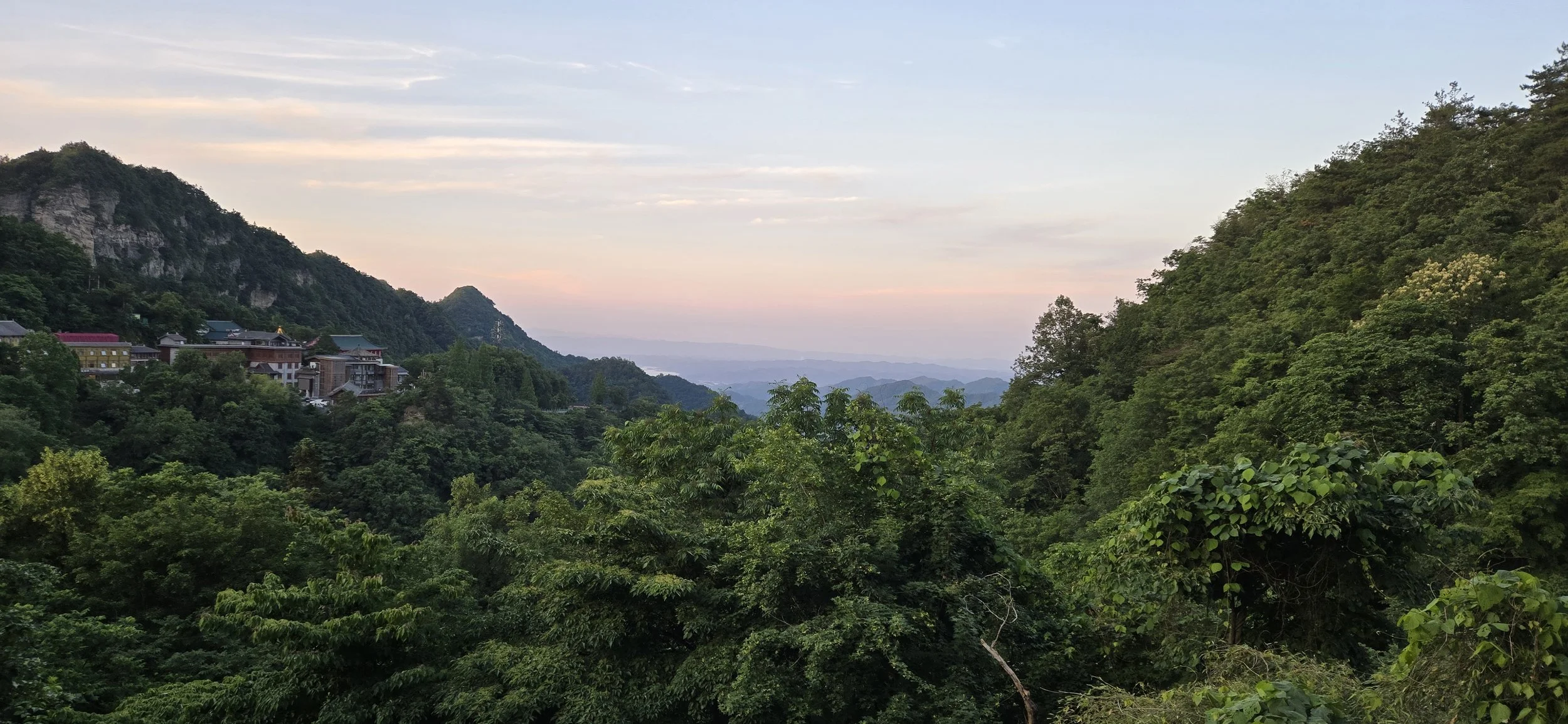
The view from our favorite restaurant at Nanyan. Wudang is so lush.
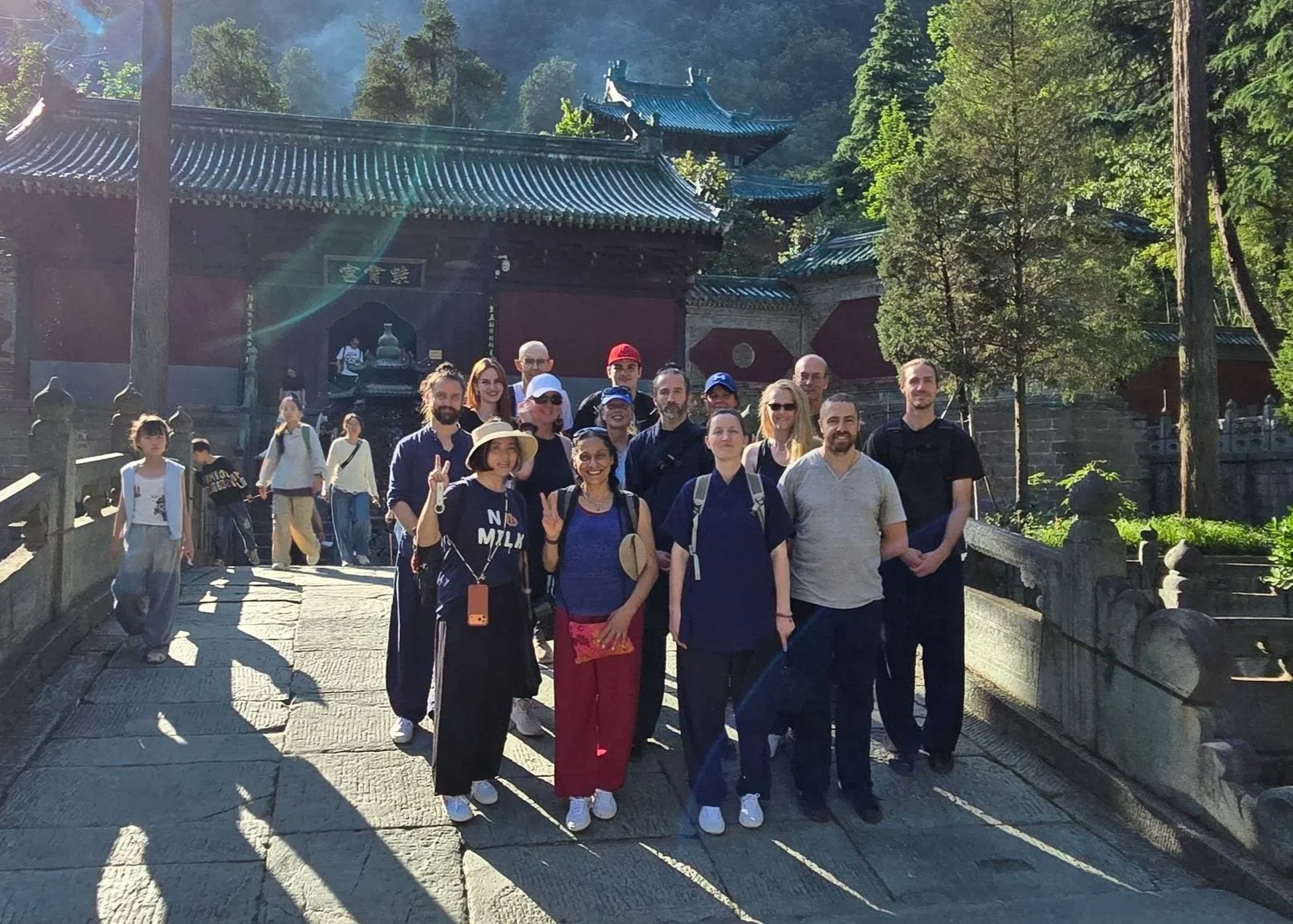
The whole group on the bridge in front of Purple Cloud Palace 紫霄宫
The next day we began the long trek up to the Golden Summit. The way up to the peak of Wudang actually has two paths — a Ming dynasty one, with plenty of little places to stop and see caves and minor temples and shrines — and a more recent Qing dynasty one that follows the natural contours of the mountains and is actually a bit more scenic. The Ming path is shorter but with more ups and downs while the Qing path is longer but steadier. This time we took the Qing path. And while it was cool to go a different way, on balance I definitely prefer the Ming path, in no small part because it is more rich with symbolism, being a map of the inner landscape of the body and also the path to enlightenment.
It was the clearest day I had ever experienced on the golden summit. Arriving up there is always a beautiful, lightening experience. Just the openness of the sky above you, the golden temple, the statue of Zhenwu. Now it’s like going back home to a place I’ve known for years. The first time I visited was the day before my 22nd birthday. I’ll be 40 this year. I often have dreams there, and so when I go back I experience this unique amalgamation of actual memories and feelings from dreams I’ve had over the decades. I think that’s how Wudang is supposed to be experienced. It’s this ideal place you probably first encountered in fiction, Wuxia stories or movies, and then you go there and you’re in the space and breathe the air and it changes, becomes more real, but then when you leave again it becomes yet a third thing, a mixture of dream and memory, fantasy and reality. And now when I go back, the entire place hovers in this space between all these realms, all these categories, everything suspended in surreal superposition.
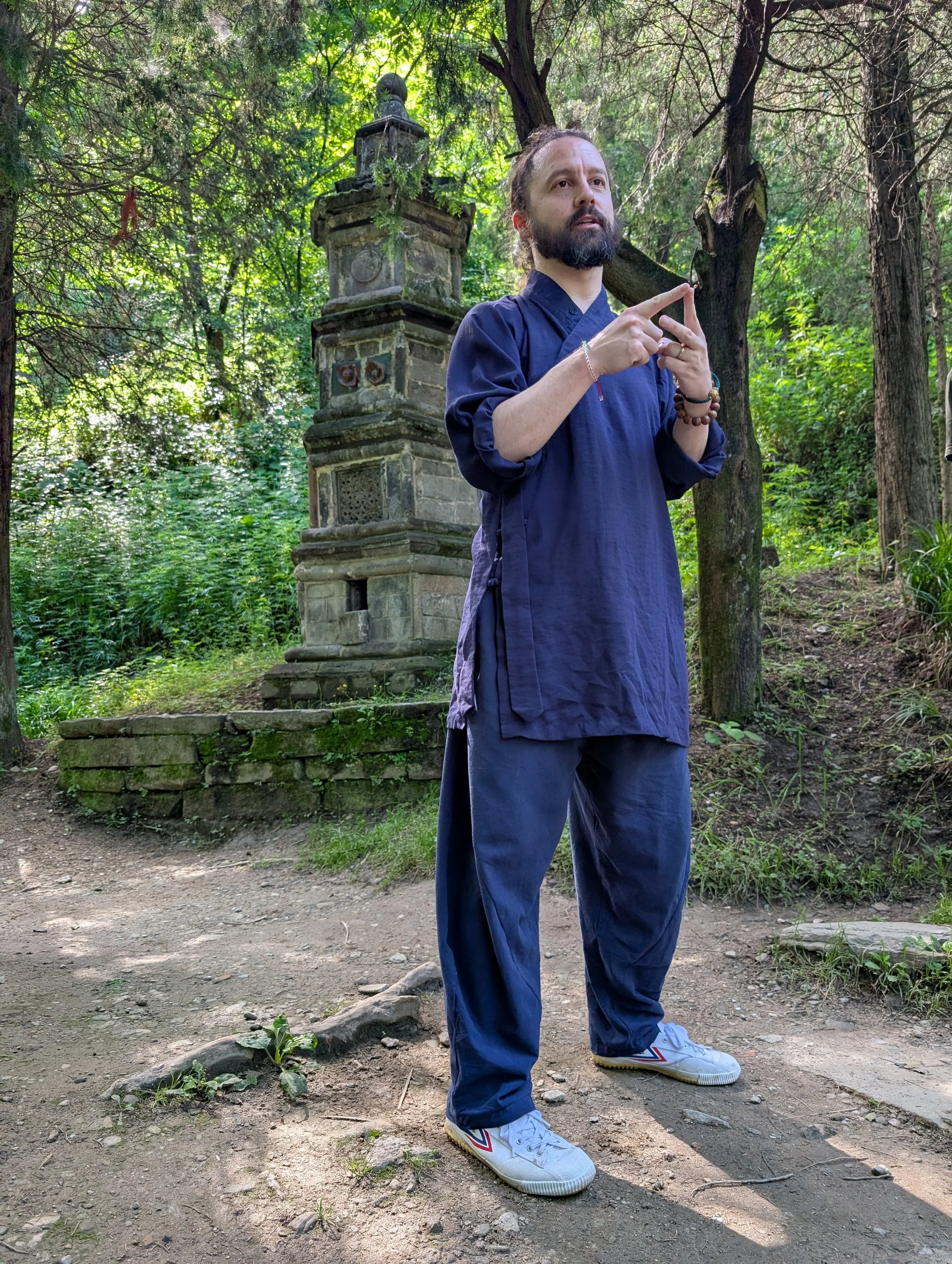
Tour guide mode. I told everyone all the interesting facts I was relaying were from 武当道教史略 by Wangguangde and Yanglizhi and Le Wudang Shan: Histoire des récits fondateurs by Pierre-Henry De Bruyn
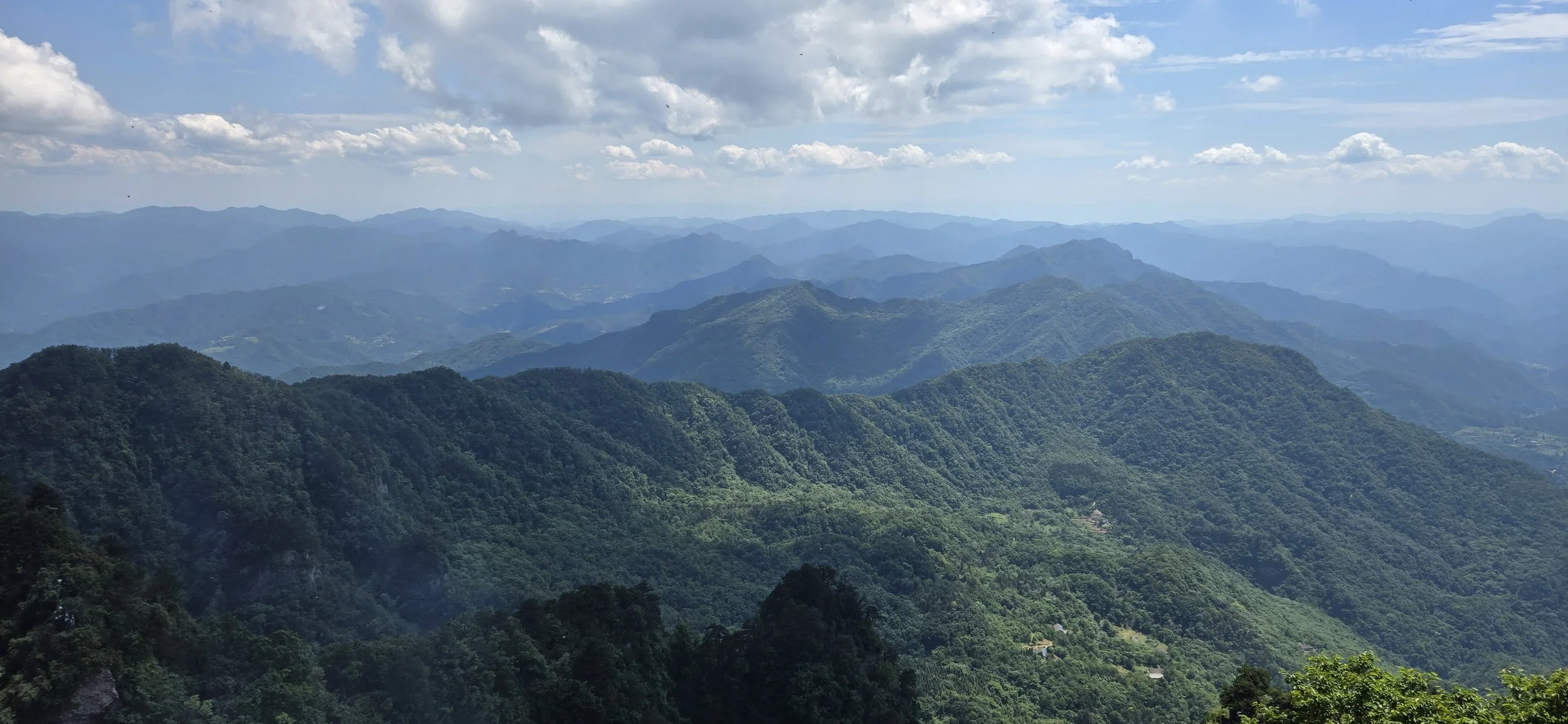
Wudang isn’t that tall, only 5,289 ft, but it is the highest mountain for almost a thousand kilometers, so incredible views on clear days
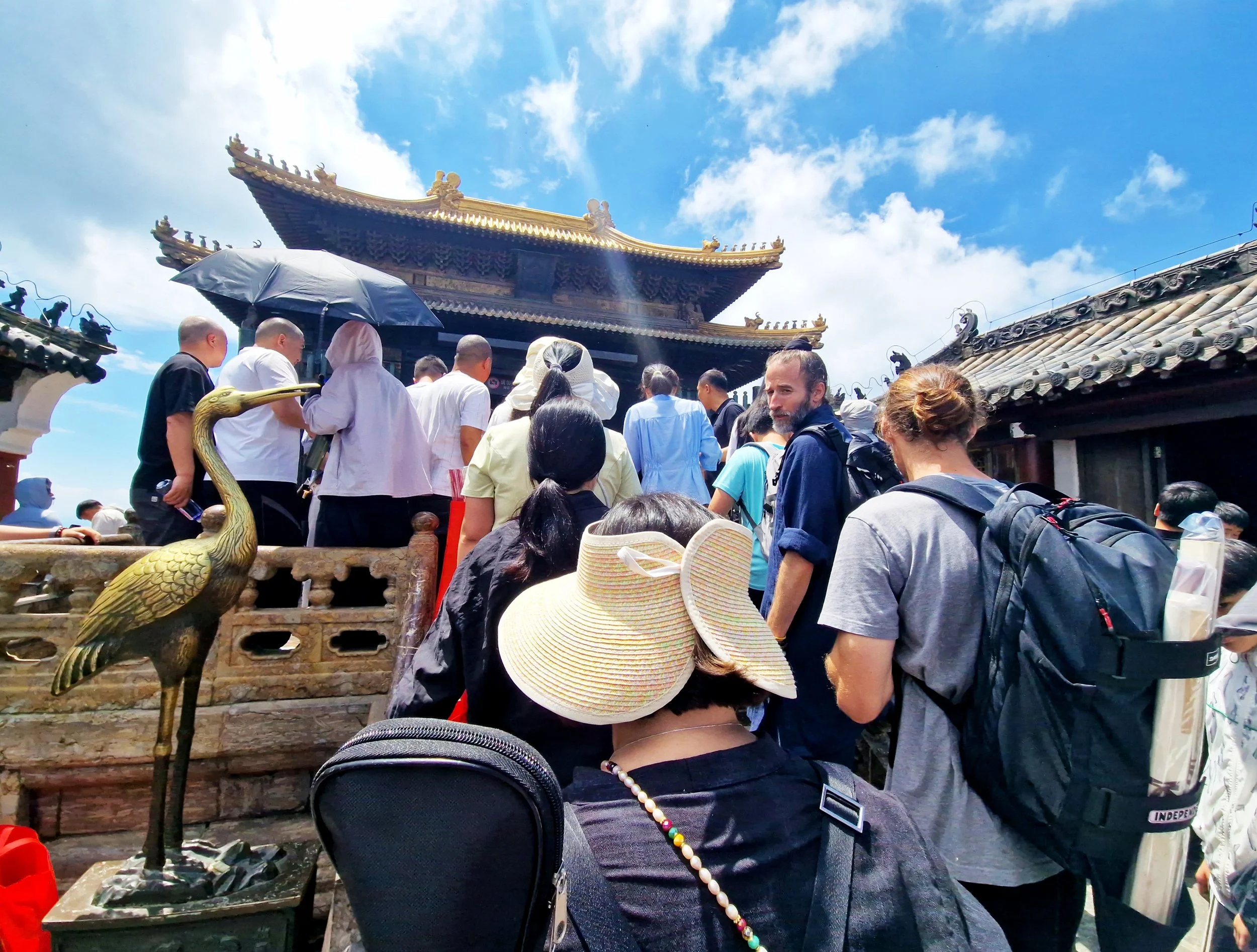
Approaching the Golden Temple 金殿
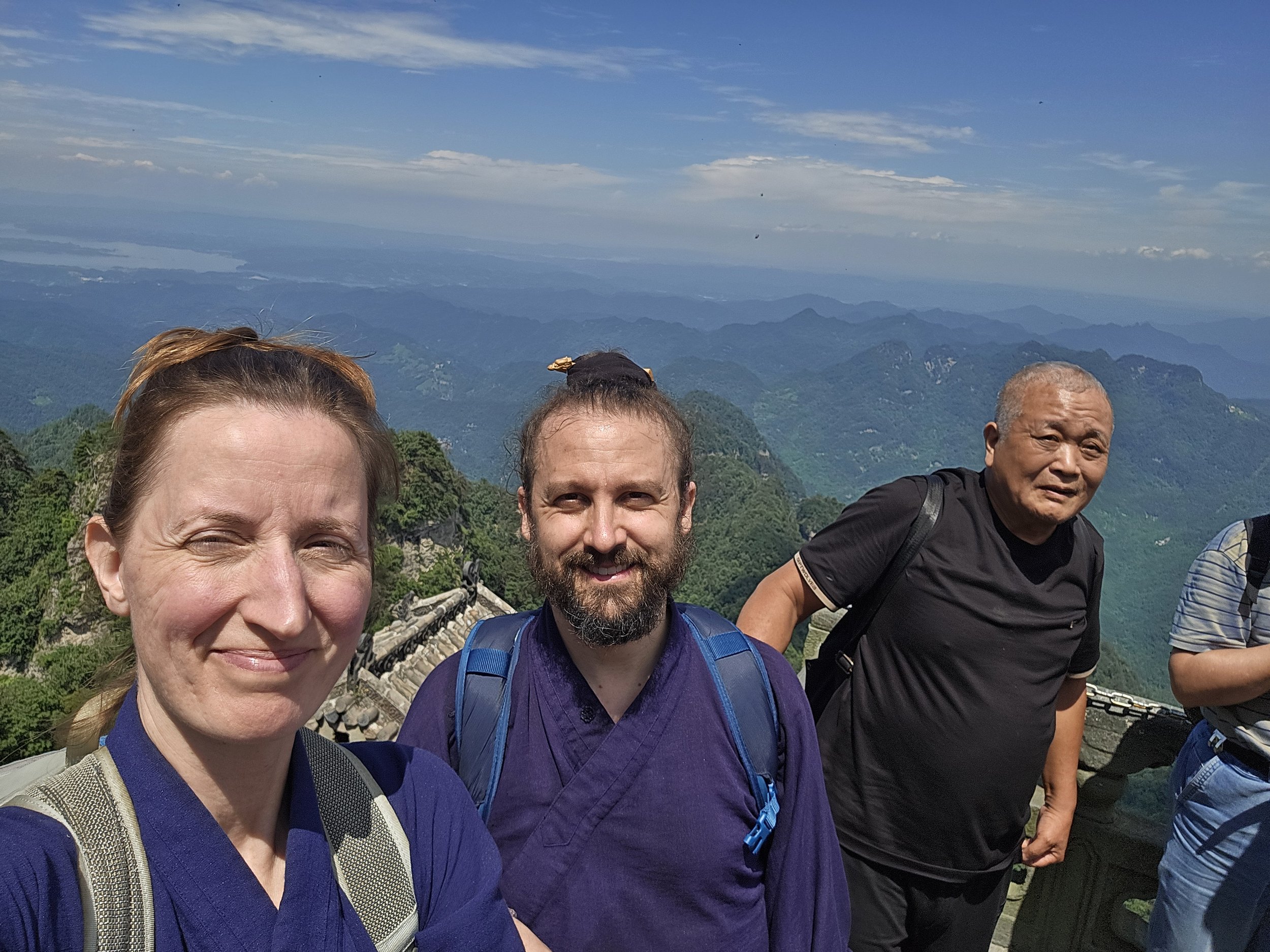
At the golden summit 金顶
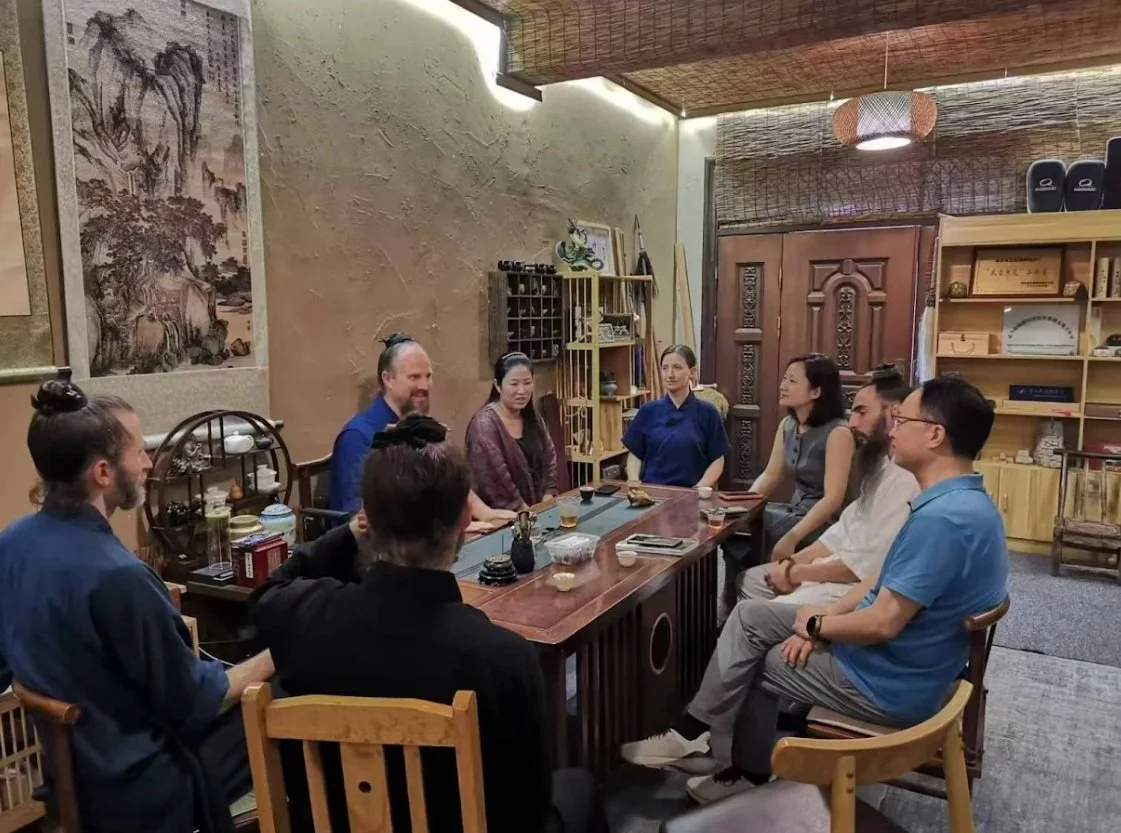
Meeting the head of the Wudang Wushu Association 武当武术协会 in Jake’s teahouse
The next day the students returned to master Yuan’s school and resumed their training while we spent our second week meeting with local officials and hanging with Jake, master Yuan, and grandmaster Zhong. First we had a meeting with the head of the Wudang Wushu association 武当武术协会 where we talked about our new little international San Feng association and the future of Wudang martial arts. He was a really cool dude, asked what he could do to help us with our schools in the west. I was able to use some advanced vocabulary I don’t often have opportunities to use in daily conversation in China, talked about my research position at Esalen, being a visiting scholar at Harvard, and how I’m trying to bring Wudang culture into these more elevated spheres in the West. Jeff spoke at length about what he’s doing through his school, in the international community, and with me at Esalen. But what was really cool was seeing Jake just in his element, operating with complete linguistic and cultural fluency talking about Wudang martial arts and culture as a platform for international conversation. He’s really found himself in this unexpected position of a kind of cultural diplomat, and it was amazing seeing him effortlessly dancing with the Wudang wushu bureaucracy like a fish in water. We dealt a lot with the local government and bureaucratic machine when we were living in China and I think I basically blocked all that stuff out of my memory, so it was kinda fun dipping a toe back into that world. Happy to just dip a toe in though and leave the heavy lifting to Jake. Happier still to return to my isolated yurt in the forest in BC, to my little school in a little town in Canada.
The next day Jake arranged for us to go visit grandmaster Zhong Yunlong 钟云龙 at the Daoist Hall of Clarity and Subtlety 清微道院, his school deep in the mountains. Master Zhong built this school maybe ten years ago, after I had already left Wudang, and I had never had a chance to visit it. It’s a little Siheyuan 四合院, a classical Chinese quadrangle that looks just like the school in Crouching Tiger Hidden Dragon, and I had so wanted to go for so very long. We had many interactions with grandmaster Zhong in the years we lived in China. I even travelled with him up to Kongtong Mountain 崆峒山 in 2011 as a delegate for the Grand Meeting of the Martial Forest 武林大会, but our interactions with him were always very formal. I’d hardly even said a word to him in all those years.
We get to his school and wait in his meeting room for a few minutes, everyone hyper conscious of etiquette and where and how we’re standing, arms full of gifts. In comes grandmaster Zhong with a huge smile on his face. After greeting us with disarming, uncharacteristic warmth, he sat down in his chair, kinda leaning to the side with a mischievous smile. A wide ranging chat ensued, Shiye treating us like we were old friends for the next three hours. It was an absolutely incredible afternoon just chopping it up with grandpa (he’s called Shiye 师爷 in Chinese, pretty much grandpa in English). We talked about everything under the sun, from the history of martial arts to contemporary Wudang drama, alchemical theory to stories of our great great grandmasters. He even dropped some historical details that Jeff and I, despite our decades of trying to piece this stuff together, never knew. He was genuinely so happy to see us, and just super forthright with us, answering every question we had with clarity and depth. We could never imagine communicating with master Zhong like this when we were younger, during our years of intensive training. It makes sense though, I mean we were all in our 20’s back then, kids in the formational stages of the path. Most people in Wudang just pass through on their way elsewhere. But here we all are, twenty years on, still doing the same stuff. There’s a kind of trust that only duration can bring to a relationship, a kind of bond that only time can forge, and it’s really amazing seeing that kind of solidifying our bonds to our brothers, to our master, and to the grandmaster.
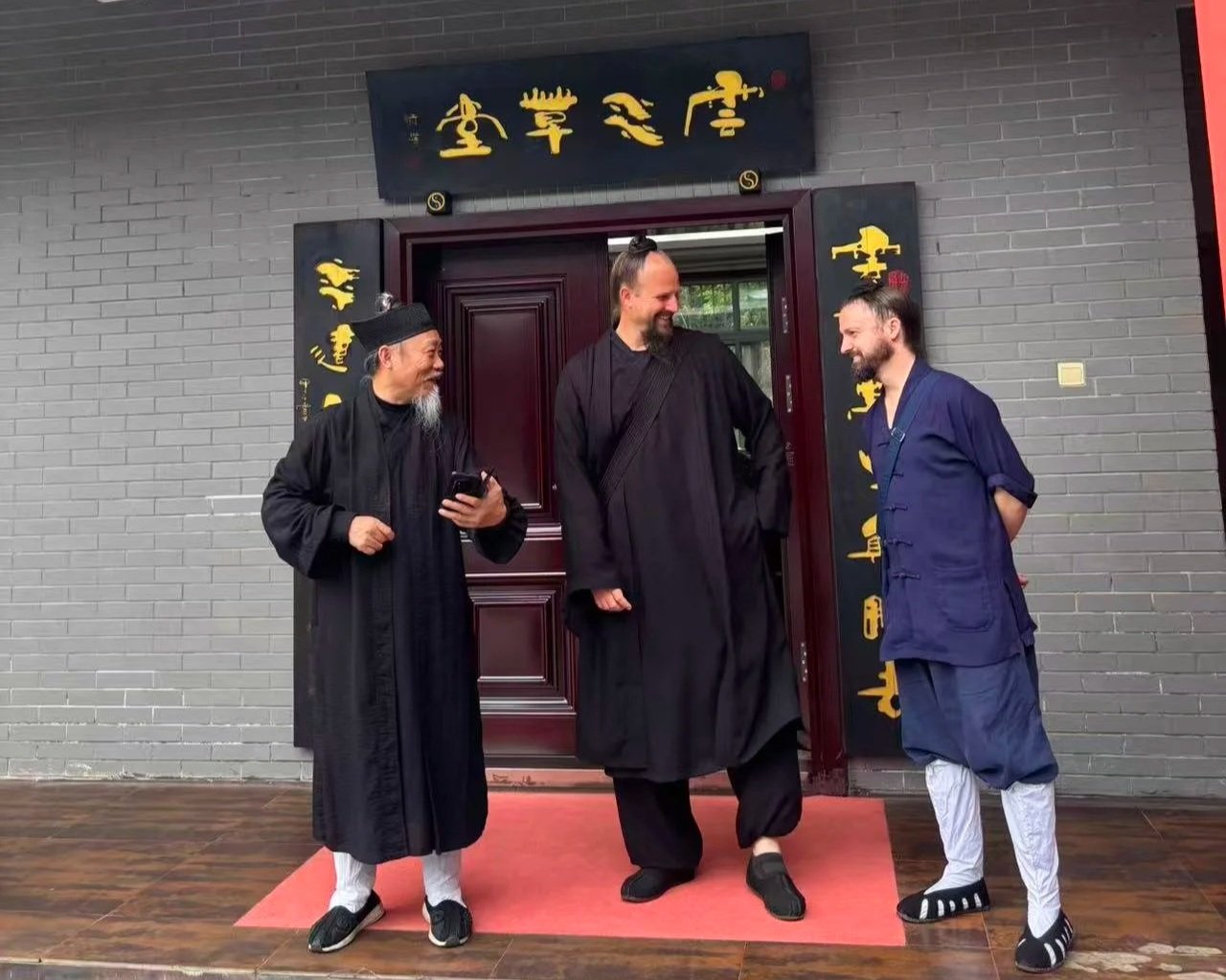
Grandpa, Jake, and Me. My favorite picture from this trip.
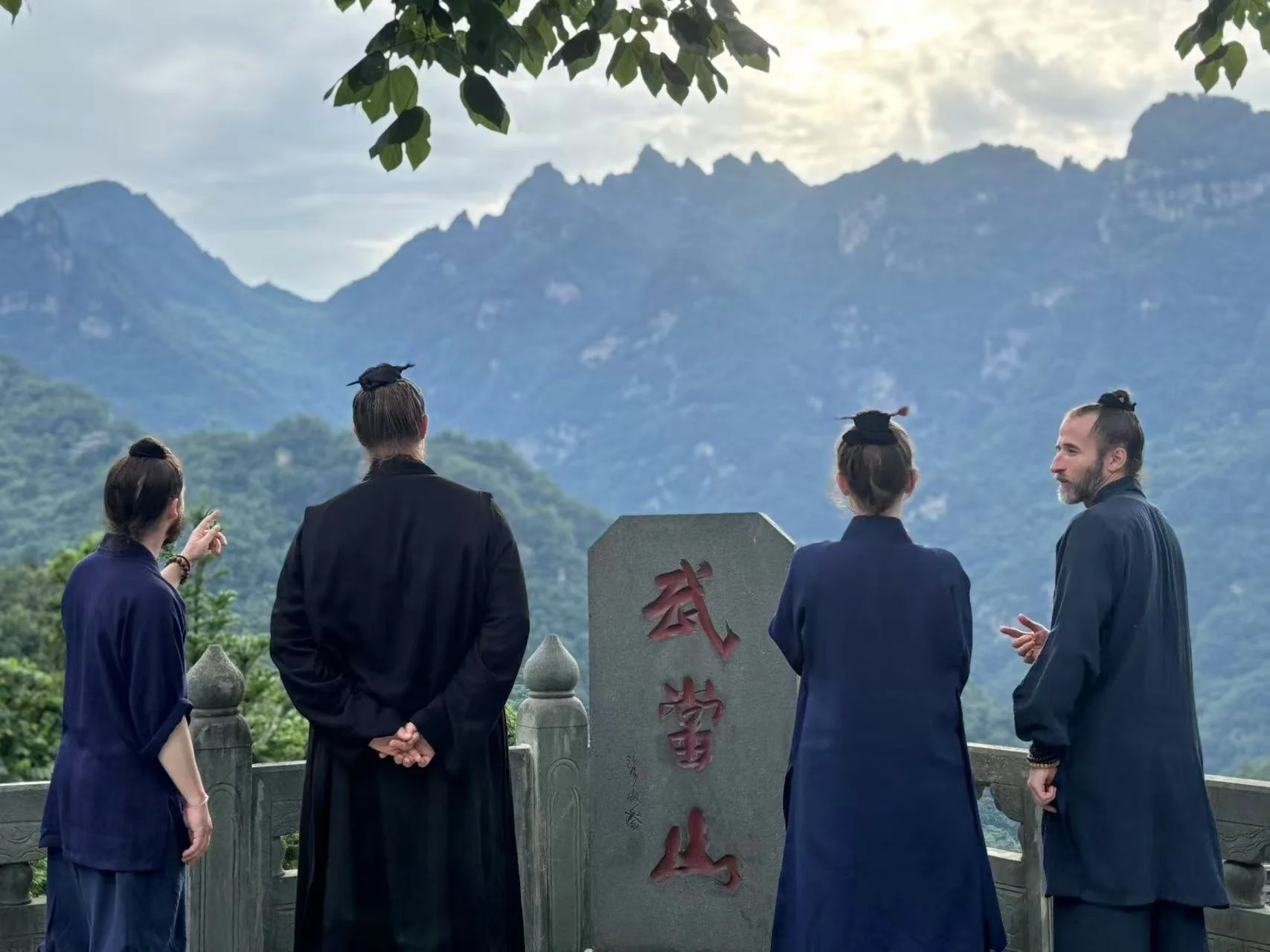
The four of us gazing up at the Golden Summit of Wudang Mountain in the distance. This is a little platform just down the way from Shiye’s school.
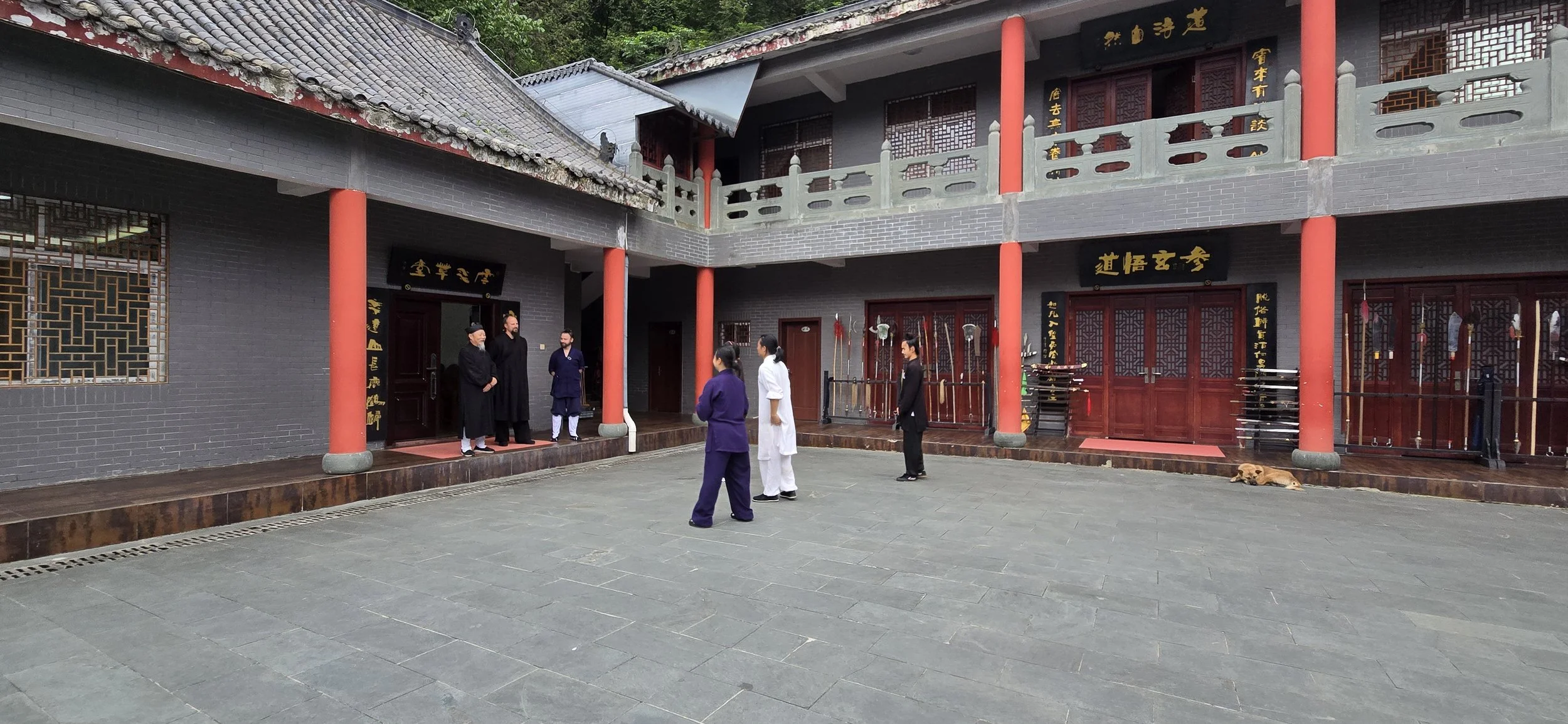
Wider view of Shiye’s school, the Qingwei Daoyuan 清微道院
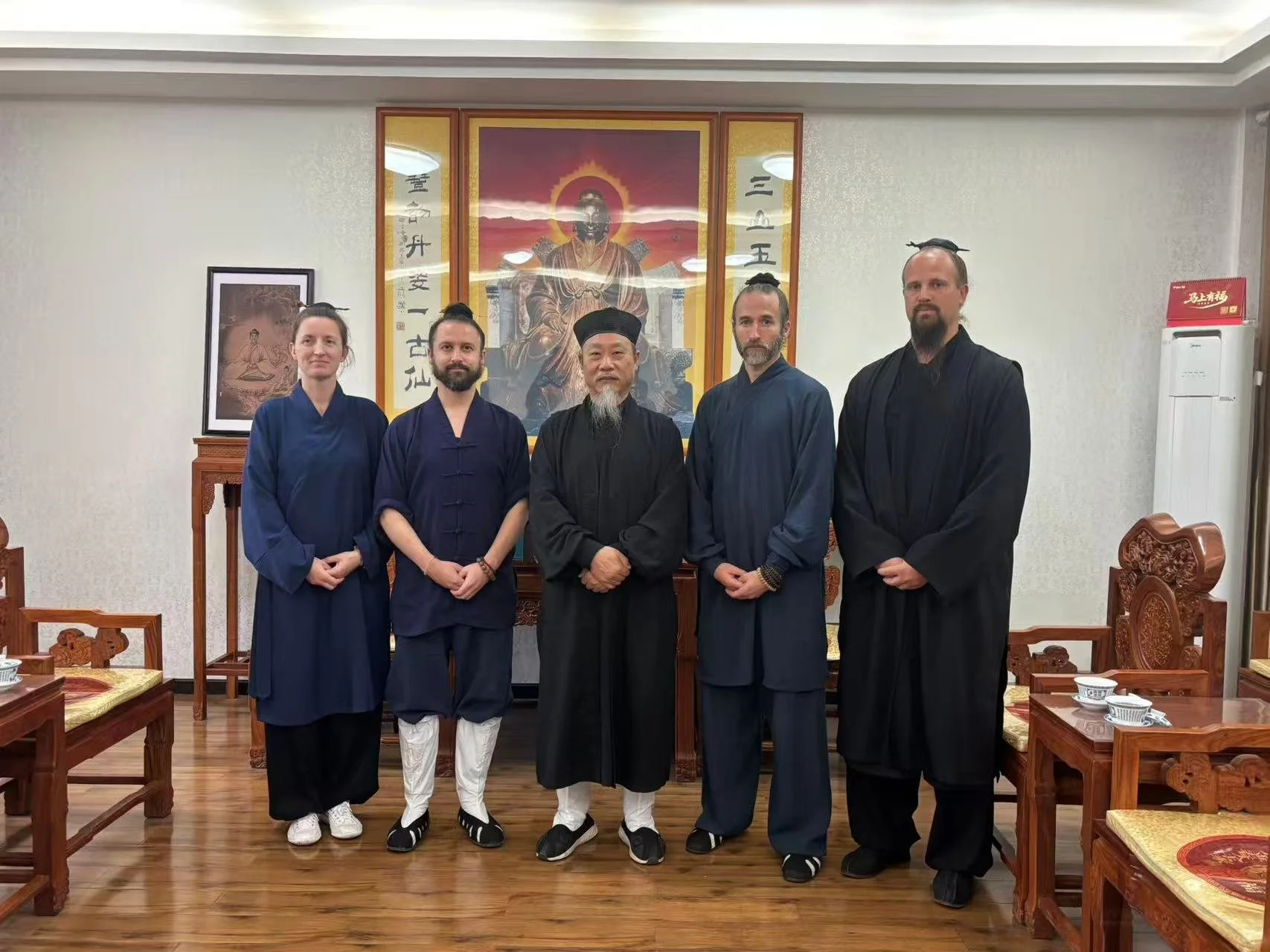
Brandi 资自, Me 资乾, Jeff 资和, and Jake 资根 with grandmaster Zhong 钟云龙 (钟清微) at the Qingwei Daoyuan 清微道院
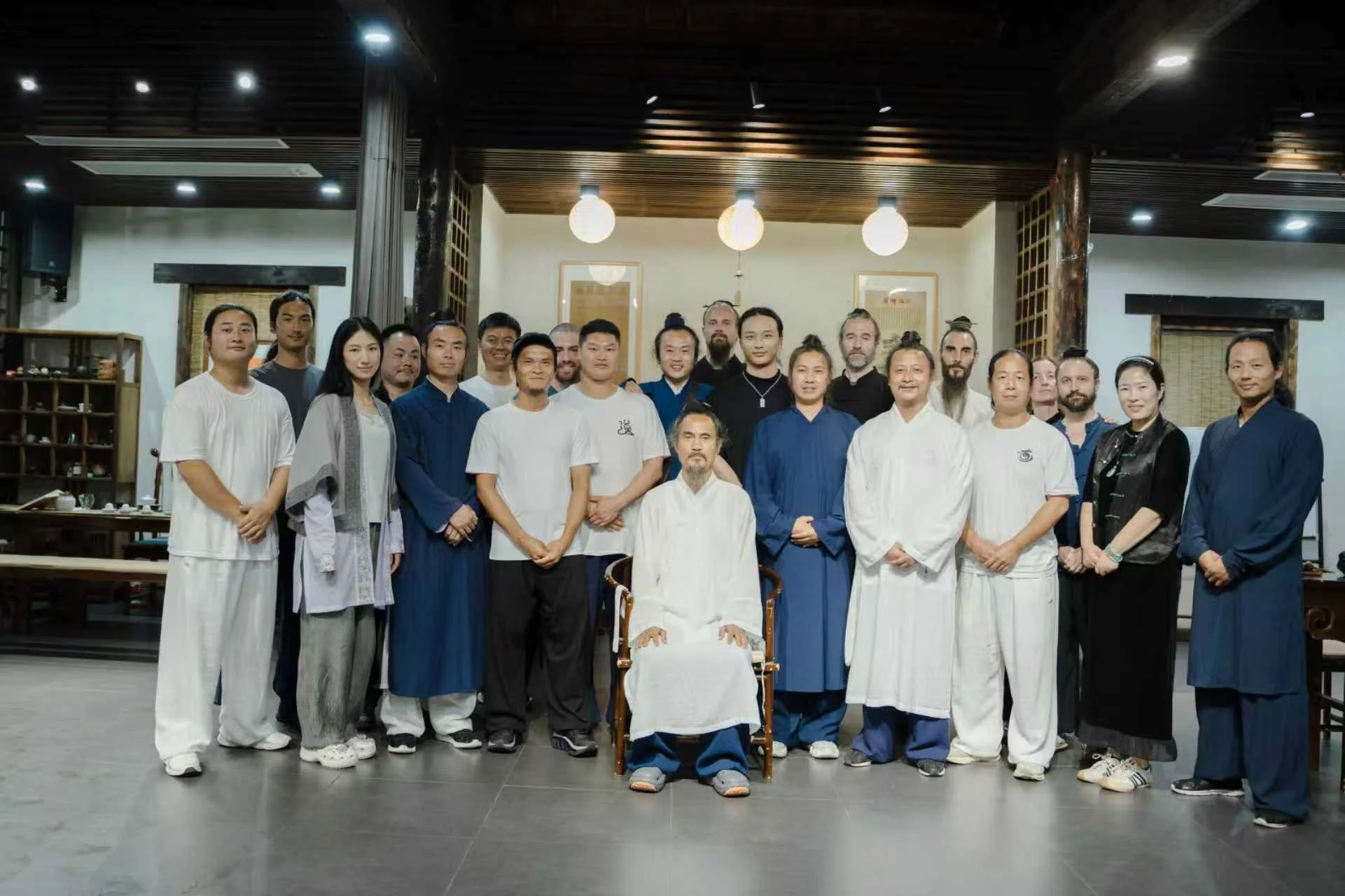
The next day we arranged for master Yuan to have a sit down, sort of question and answer session with all the students we had brought along. We all gathered in Shifu’s tearoom in the evening, along with a few of our Chinese brothers, Shenfeng 袁慎峰 (资隽) and Shencai 袁慎才 (资皓). Jeff, Brandi, and I very comfortably took our seats, I mean, it’s just master Yuan, you know? But all of our students came in with that same kind of tense formality that we had just brought to grandmaster Zhong’s school the day before. Everyone sat in a ring around the room and Shifu poured tea for every single person. I delivered the cups and made sure we each had some puer tea, and then we began with a toast, Shifu welcoming everyone to Wudang. I’m not really sure what to write about here…about what Shifu talked about. It was another three-hour session. We’ve talked to our students since then and everyone seems to remember a different thing, a different part they latched onto. What was really notable was that over the course of this tea session with Shifu everyone in the room grew so relaxed, so open, and by the end there was this palpable feeling of lightness, a kind of glow. Shifu’s big message was that people these days are so very lost, they’ve lost contact with the very foundations of life. He characterized his advice as “2+1:” sleep well 睡好, eat well 吃好, and work well 工作好. Two of those are not an option. In this life, in this body, we must sleep and we must eat, so no matter if you’re a beggar or the richest person in the world, you have to negotiate with these two. Beyond those, depending on your phase of life you should either study well or work well. And that’s it, he said. Life is simple! If your life seems complicated, well, that is your choice. Get back to 2+1. During his talk, Shifu said something — precisely something a character in a dream I had told me back in 2020. It’s a long and strange story, but because of that I’m now working on memorizing the Scripture of the Yellow Court 黄庭经.
While we were there I told our students that Wudang is like a dream. It can change your life, but you have to let it. You have to consciously incorporate it into who you are. Wudang has now been a part of me for half of the time I’ve spent on this earth, and like Uncle Wang’s homebrew, Wudang relationships deepen and complexify with time. Our relationships with our brothers, as we all approach middle age, take on new meaning as fading youth foregrounds the things that are really important in this life. Our relationships with our masters — master Yuan and grandmaster Zhong — where we’re like children growing up, getting to know their parents from a different perspective, something more closely resembling equal footing. But most striking perhaps is our relationships with Wudang, the place, the space, you could call it the energy, or maybe the spirits. I knew nothing when I moved there at age 21. I didn’t even know who Zhenwu was, I didn’t know what any of it was about, allowing me to have a kind of childlike experience of embodied immersion in a wholly alternate world. Slowly, slowly, amidst this primarily embodied immersion, different kinds of understanding grew through the practices, and later I layered a bit of knowledge on top of it. Now when I go back to Yuxugong 玉虚宫, the temple where we trained, I get this feeling of being embraced by a parent, like this temple space is my Daoist mother. I feel like the temples of Wudang, these bastions of an ancient and silent wisdom, find us cute, like we are little kittens running around, and they have this intractable compulsion to raise these hapless kittens on the path. I try to hold my knowledge lightly around my students, to facilitate that same sort of embodied immersion that can be spoiled by too much theoretical knowledge. Daoism has always had a beautiful veneration of wild youthful ignorance, and every time I go back to Wudang, I get a new appreciation for what a gift it was for me to go there as a kid, knowing nothing.
So much space for transformation 化.
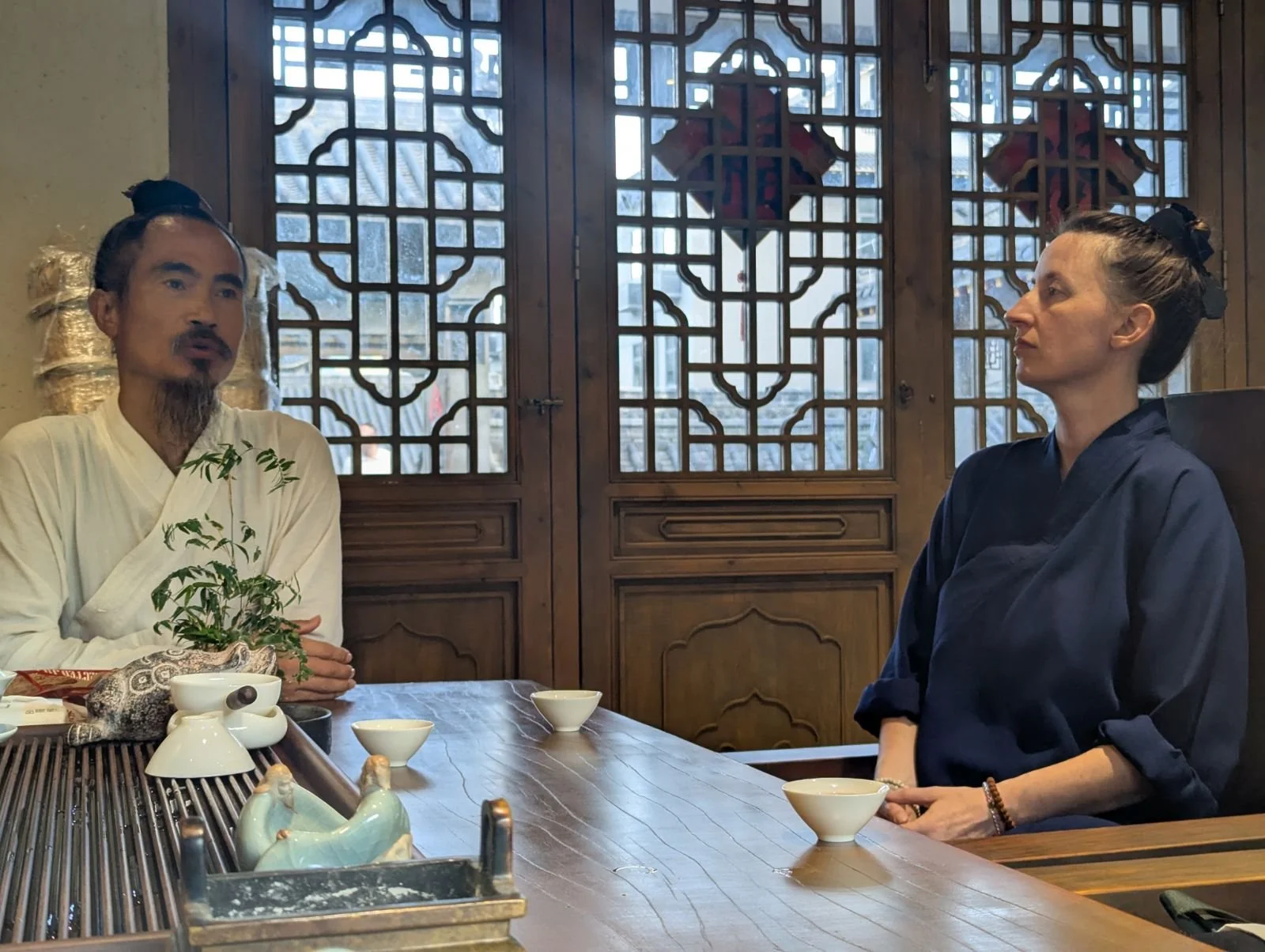
Brandi and Shifu during his lecture for our students
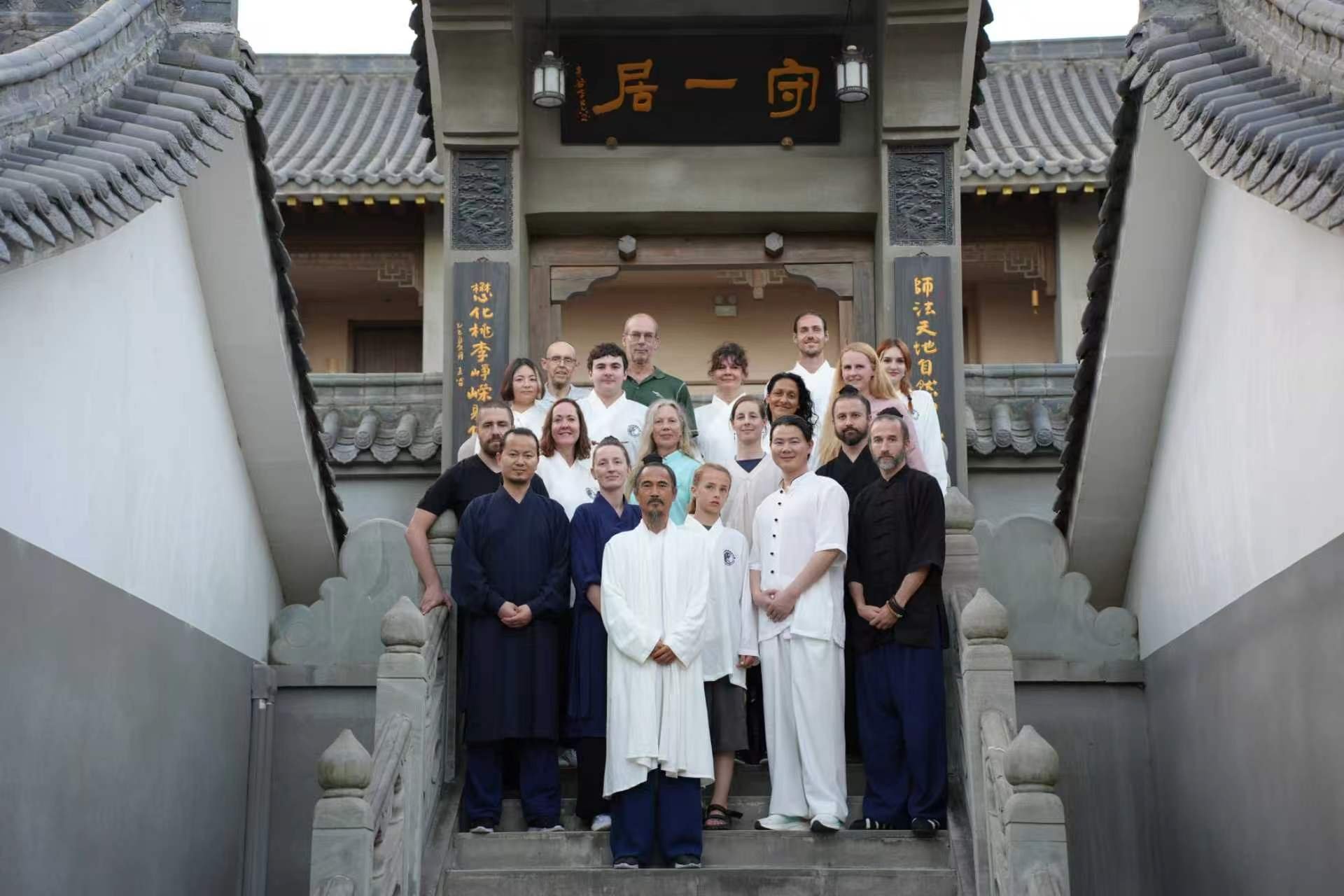
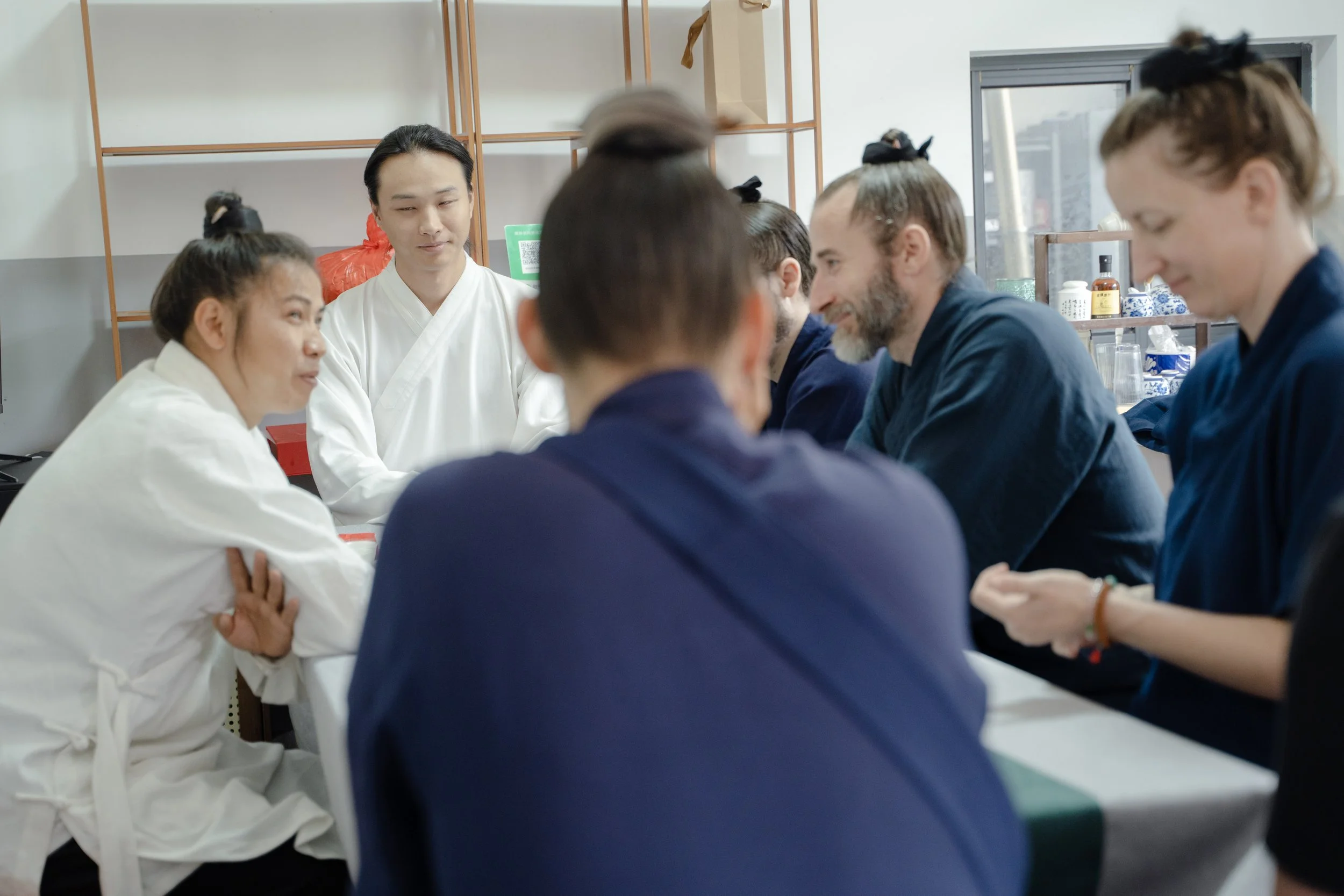
Shifu with all our students after the talk
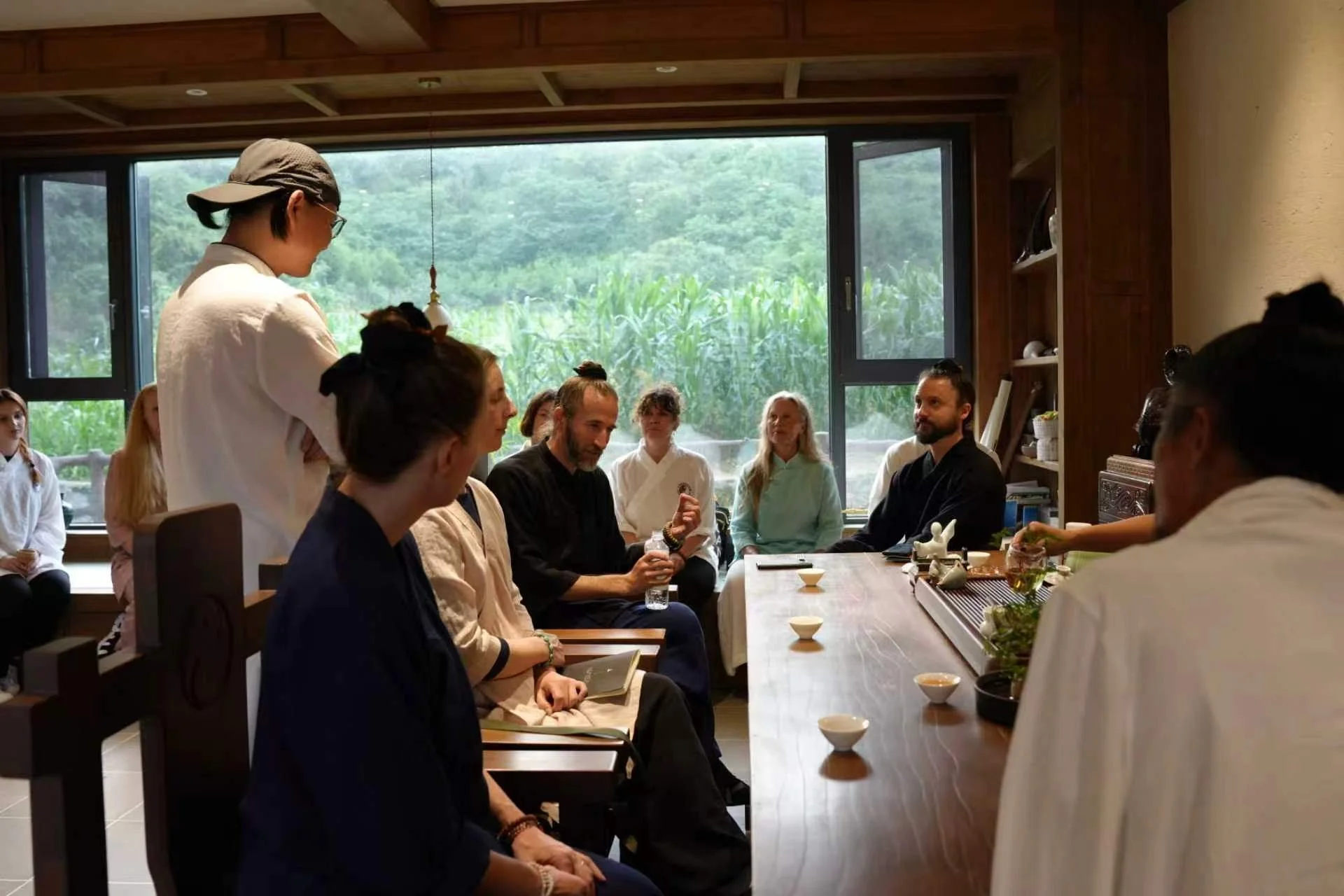
Jeff translating, Shencai, shifu’s first disciple, in the cap
